Shapes in English: Learn the Names of 2D and 3D Shapes
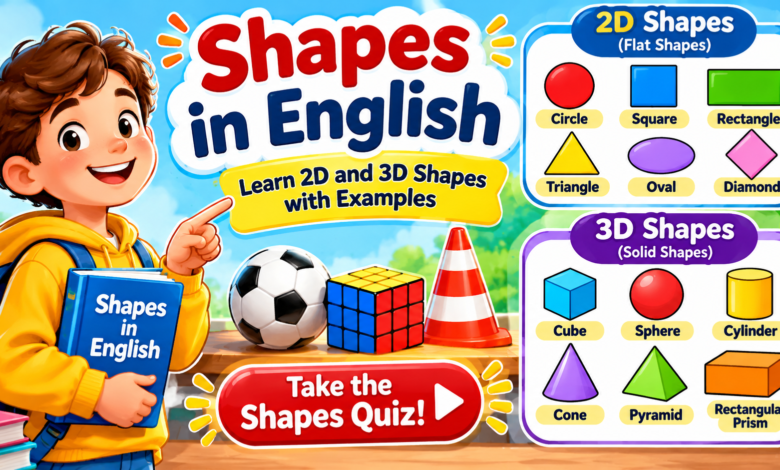
Shapes are everywhere around us! We can see them in our homes, classrooms, buildings, toys, and even in nature. Learning the names of shapes in English is an important part of building basic vocabulary, especially for beginners and young English learners.
In this lesson, you will discover the names of common 2D and 3D shapes, learn about their properties, and explore examples from everyday life. By the end, you will be ready to test your knowledge with our interactive Shapes in English Quiz!
1. What Are Shapes?
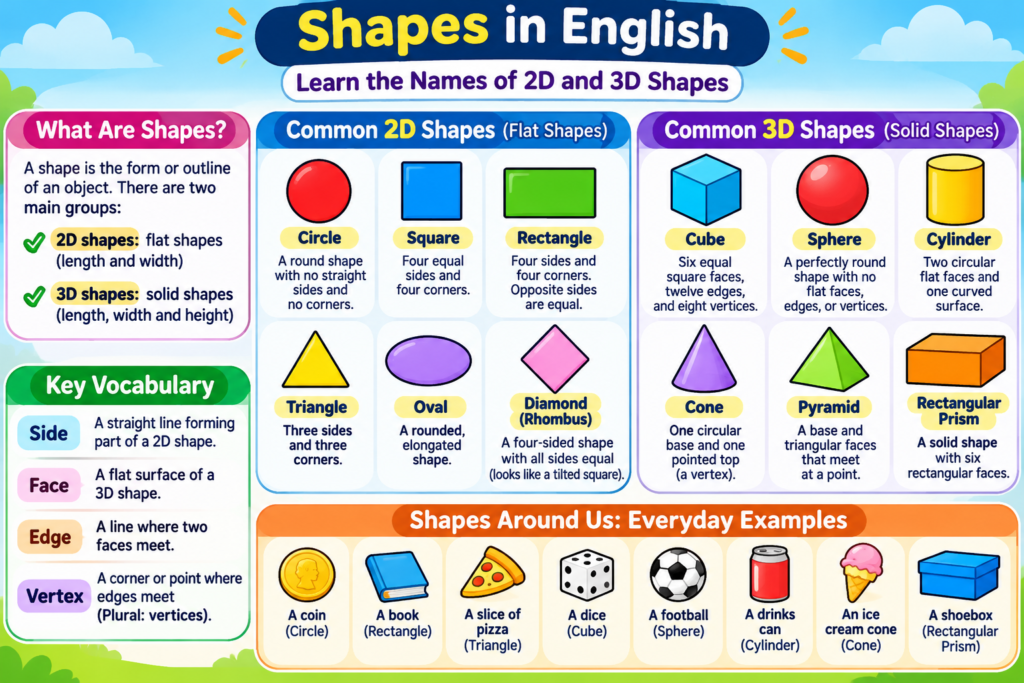
A shape is the form or outline of an object. Shapes can be classified into two main groups:
- 2D shapes (Two-dimensional shapes): These are flat shapes with two dimensions: length and width.
- 3D shapes (Three-dimensional shapes): These are solid shapes with three dimensions: length, width, and height.
Let’s explore some common examples.
2. Common 2D Shapes in English
Two-dimensional shapes are flat. They have sides and corners, but they do not have depth.
Here are some important shape names to learn:
Circle
A circle is a round shape with no straight sides and no corners.
Examples: A clock, a coin, a wheel, and a plate.
Square
A square has four equal sides and four corners.
Examples: A chessboard square, a floor tile, and a square picture frame.
Rectangle
A rectangle has four sides and four corners. Its opposite sides are equal in length.
Examples: A door, a book cover, a television screen, and a window.
Triangle
A triangle has three sides and three corners.
Examples: A triangular road sign, a slice of pizza, and a roof shape.
Oval
An oval is a rounded, elongated shape.
Examples: An egg, a rugby ball, and some mirrors.
Diamond
A diamond shape looks like a square tilted on one of its corners. It is also called a rhombus when all four sides are equal.
Examples: Some road signs and decorative patterns.
3. Common 3D Shapes in English
Three-dimensional shapes are solid objects. Unlike flat shapes, they have length, width, and height.
Cube
A cube has six equal square faces, twelve edges, and eight vertices (corners).
Examples: A dice, an ice cube, and a Rubik’s Cube.
Sphere
A sphere is perfectly round, like a ball. It has no flat faces, edges, or vertices.
Examples: A football, a basketball, and a globe.
Cylinder
A cylinder has two circular flat faces and one curved surface.
Examples: A can of juice, a water bottle, and a roll of paper towels.
Cone
A cone has one circular base and one pointed top called a vertex.
Examples: An ice cream cone, a party hat, and a traffic cone.
Pyramid
A pyramid has a base and triangular faces that meet at a point.
Examples: The famous Egyptian pyramids and some decorative objects.
Rectangular Prism
A rectangular prism is a solid shape with six rectangular faces.
Examples: A shoebox, a brick, and a cereal box.
4. Important Vocabulary: Sides, Faces, Edges, and Vertices
When describing shapes in English, it is useful to know these words:
- Side: A straight line forming part of a 2D shape.
- Face: A flat surface of a 3D shape.
- Edge: A line where two faces meet.
- Vertex: A corner or point where edges meet. The plural form is vertices.
For example, a cube has six faces, twelve edges, and eight vertices.
5. Shapes Around Us: Everyday Examples
Learning shapes becomes easier when you connect them to objects you already know.
| Everyday object | Shape |
|---|---|
| A coin | Circle |
| A book | Rectangle |
| A slice of pizza | Triangle |
| A dice | Cube |
| A football | Sphere |
| A drinks can | Cylinder |
| An ice cream cone | Cone |
| A shoebox | Rectangular prism |
Look around your room. Can you find a circle, a rectangle, or a cube? You may be surprised by how many shapes you can identify!
6. Why Is Learning Shapes in English Important?
Learning shapes helps English learners develop essential vocabulary and describe the world around them. It is also useful in everyday conversations, classroom activities, mathematics, and reading comprehension.
For example, you can use shape vocabulary in sentences such as:
- The clock is round.
- My notebook is rectangular.
- The ball is spherical.
- The window has a rectangular shape.
- The box is shaped like a cube.
Try using these words when describing objects around you. The more you practise, the easier it becomes to remember them!
7. Test Your Knowledge: Shapes in English Quiz
Now that you have learned the names and properties of common 2D and 3D shapes, it is time to put your knowledge to the test!
Our interactive Shapes in English Quiz is a fun way to practise shape vocabulary, identify different geometric shapes, and check how much you have learned.
Challenge yourself, answer the questions, and see how well you can do. Don’t worry if you make mistakes — every question is an opportunity to learn something new!
🎯 Ready to Play?
Click the quiz button below to start the Shapes in English Quiz. Good luck, and have fun learning! 🎉