Can and Can’t in English: How to Use Them with Examples
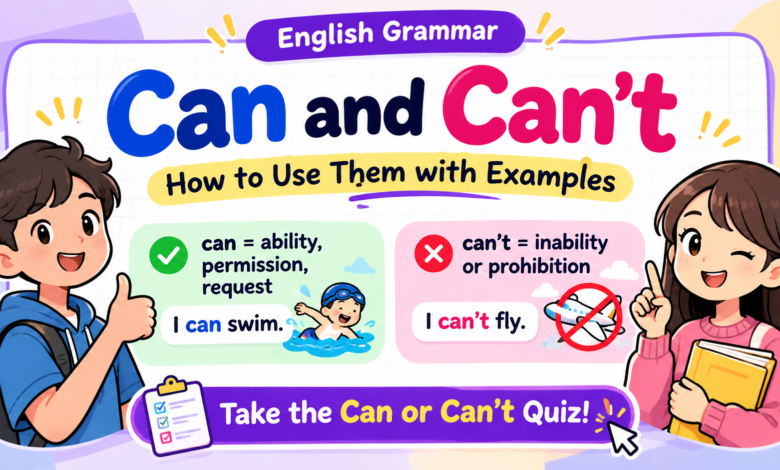
Learning how to use can and can’t in English is an important step for beginners and elementary English learners. These two common modal verbs help us talk about abilities, ask for permission, make requests, and express things that are impossible or not allowed.
But when should you use can, and when should you use can’t?
In this easy English grammar guide, you will learn the difference between can and can’t, understand their grammatical rules, and practise using them through simple examples.
1. What Does “Can” Mean?
We use can to express ability, possibility, permission, and requests.
A. Can for Ability
We use can to talk about things that someone is able to do.
Examples:
- I can swim. 🏊
- She can speak three languages.
- My brother can play the guitar.
- Birds can fly.
- They can solve difficult problems.
In these examples, can tells us what someone or something is able to do.
B. Can for Permission
We also use can to ask for or give permission.
Examples:
- Can I use your phone?
- Can we go outside?
- You can leave the classroom now.
- Students can use dictionaries during the activity.
C. Can for Requests
We can use can to ask someone to do something.
Examples:
- Can you help me, please?
- Can you open the window?
- Can you repeat that sentence?
- Can you give me a glass of water?
2. What Does “Can’t” Mean?
Can’t is the contraction of cannot. We use it to express inability or something that is not permitted.
A. Can’t for Inability
We use can’t when someone is unable to do something.
Examples:
- I can’t drive a car.
- A baby can’t walk.
- My little sister can’t swim.
- He can’t speak Japanese.
- We can’t hear you clearly.
B. Can’t for Prohibition
We also use can’t to say that something is not allowed.
Examples:
- You can’t smoke here.
- Students can’t use their phones during the exam.
- You can’t park your car in front of this gate.
- Children can’t enter this room without an adult.
3. The Grammar Rule: How to Form Sentences with Can and Can’t
One of the best things about can and can’t is that they are easy to use.
The verb that follows them must always be in its base form (infinitive without to).
Affirmative Sentences
Structure:
Subject + can + base form of the verb.
Examples:
- She can dance.
- He can cook.
- They can play football.
Negative Sentences
Structure:
Subject + can’t + base form of the verb.
Examples:
- She can’t dance.
- He can’t cook.
- They can’t play football.
Questions
Structure:
Can + subject + base form of the verb + ?
Examples:
- Can you swim?
- Can she drive?
- Can they speak English?
Short Answers:
- Yes, I can.
- No, I can’t.
- Yes, she can.
- No, she can’t.
4. Important Grammar Rules to Remember
There are a few common mistakes that English learners should avoid.
Rule 1: Never add -s to the verb after can.
❌ She can speaks English.
✅ She can speak English.
Rule 2: Never use “to” after can.
❌ I can to swim.
✅ I can swim.
Rule 3: Can stays the same with all subjects.
- I can sing.
- You can sing.
- He can sing.
- She can sing.
- We can sing.
- They can sing.
Rule 4: Use the base form of the verb after can’t.
❌ He can’t plays tennis.
✅ He can’t play tennis.
5. Can vs. Can’t: Quick Comparison
| Can | Can’t |
|---|---|
| I can swim. | I can’t swim. |
| She can drive. | She can’t drive. |
| He can cook. | He can’t cook. |
| They can come. | They can’t come. |
| You can enter. | You can’t enter. |
Remember:
- CAN = ability, possibility, permission or request.
- CAN’T = inability or prohibition.
6. Practise with These Everyday Examples
Read the following sentences and notice how can and can’t are used:
- A fish can swim, but it can’t fly.
- I can speak English, but I can’t speak Chinese.
- You can play in the garden, but you can’t play in the street.
- My father can drive, but my mother can’t.
- Can you help me with my homework?
- Can I borrow your book?
The more you practise, the easier it becomes to use these modal verbs correctly!
7. Test Your English Grammar: Can or Can’t?
Now it’s time to check what you have learned! 🎯
Do you know when to use can and when to use can’t?
Try our interactive English grammar quiz below. It contains 20 multiple-choice questions, with only two answer choices for each question.
You will receive instant feedback, helpful explanations, and your final score when you finish.
📝 Challenge yourself and see how many questions you can answer correctly!
👇 Start the Can or Can’t English Grammar Quiz below and test your knowledge!