Simple Present vs. Present Continuous: Rules, Uses, and Examples
Learning the difference between the Simple Present and the Present Continuous is an essential step in improving your English grammar. Both tenses are used to talk about the present, but they describe different situations.
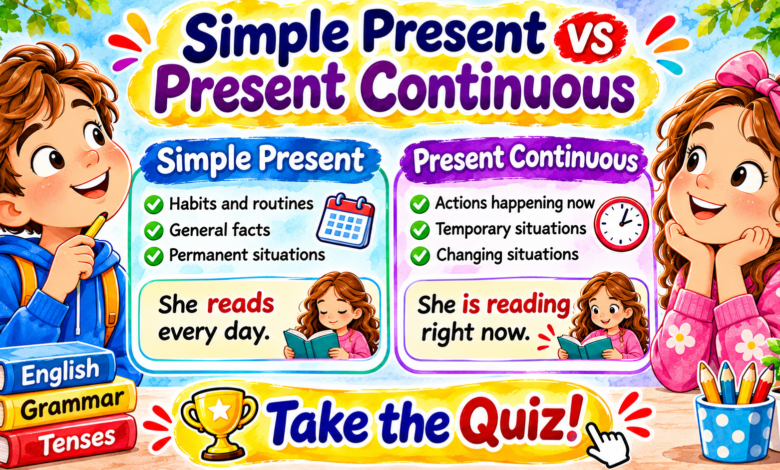
The Simple Present is mainly used for habits, routines, and general facts, while the Present Continuous describes actions happening now or temporary situations.
In this lesson, you’ll learn how to form and use both tenses, understand their differences, and practise with useful examples.
💚 1. The Simple Present Tense
We use the Simple Present to talk about things that happen regularly, habits, routines, and facts that are generally true.
When do we use the Simple Present?
A. Habits and daily routines
We use it to describe actions that we do regularly.
Examples:
- I wake up at 7 o’clock every morning.
- She drinks coffee before work.
- They play football every weekend.
- My father reads the newspaper every day.
B. General facts and scientific truths
We use the Simple Present for facts that are always or generally true.
Examples:
- The sun rises in the east.
- Water boils at 100°C at sea level.
- Birds have wings.
- The Earth revolves around the Sun.
C. Permanent situations
We can also use it to describe situations that are generally permanent.
Examples:
- She lives in London.
- My brother works in a hospital.
- They speak three languages.
How do we form the Simple Present?
Positive sentences
- I / You / We / They + base verb
- He / She / It + verb-s or verb-es
Examples:
- I work in a school.
- They study English.
- He works in a school.
- She watches television.
Remember: With he, she, and it, we usually add -s or -es to the main verb.
Negative sentences
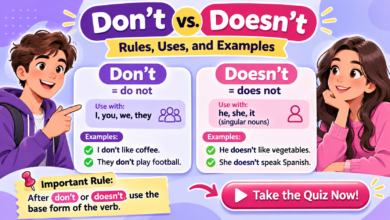
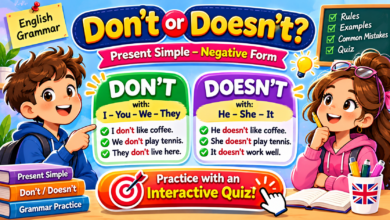
Use do not (don’t) or does not (doesn’t) followed by the base form of the verb.
Examples:
- I don’t like spicy food.
- They don’t live here.
- He doesn’t play tennis.
- She doesn’t work on Sundays.
Notice that after doesn’t, the main verb returns to its base form: doesn’t work, not doesn’t works.
Questions
Use Do or Does at the beginning of the question.
Examples:
- Do you speak English?
- Do they work together?
- Does he like football?
- Does she live near here?
💙 2. The Present Continuous Tense
We use the Present Continuous to describe actions happening at the moment of speaking or situations that are temporary.
It is also called the Present Progressive.
When do we use the Present Continuous?
A. Actions happening right now
Use it when an action is taking place at the moment you are speaking.
Examples:
- I am writing an email right now.
- She is cooking dinner.
- They are playing outside.
- The baby is sleeping.
B. Temporary situations
We use it for situations that are happening around the present time but may not be permanent.
Examples:
- I am staying with my uncle this week.
- She is working on a new project.
- They are learning Spanish this year.
C. Changing situations and developments
We can use it to describe things that are changing or developing.
Examples:
- The weather is getting warmer.
- Technology is changing our lives.
- More people are using electric cars.
How do we form the Present Continuous?
The structure is:
Subject + am / is / are + verb-ing
Positive sentences
- I am studying English.
- He is watching television.
- She is reading a book.
- We are having lunch.
- They are playing football.
Negative sentences
Add not after am, is, or are.
Examples:
- I am not sleeping.
- He isn’t working today.
- She isn’t watching TV.
- They aren’t listening to music.
Questions
Put am, is, or are before the subject.
Examples:
- Are you studying?
- Is he working now?
- Is she cooking dinner?
- Are they playing football?
💜 3. Simple Present vs. Present Continuous: What’s the Difference?
The most important difference is that the Simple Present describes habits and facts, whereas the Present Continuous describes actions happening now or temporary situations.
Compare these sentences:
| Simple Present | Present Continuous |
|---|---|
| I read every evening. | I am reading now. |
| She works in a bank. | She is working from home this week. |
| They play football on Sundays. | They are playing football at the moment. |
| He drinks tea every morning. | He is drinking coffee right now. |
Notice how the meaning changes depending on the tense.
For example:
- She teaches English. This describes her regular job.
- She is teaching English now. This tells us what she is doing at this moment.
💛 4. Common Time Expressions
Certain words and expressions can help you identify which tense to use.
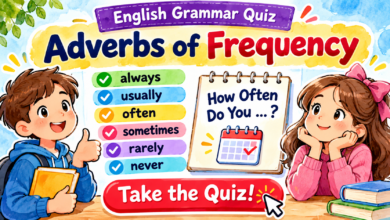
Simple Present
- Always
- Usually
- Often
- Sometimes
- Rarely
- Never
- Every day
- Every morning
- Once a week
Example: He usually walks to school.
Present Continuous
- Now
- Right now
- At the moment
- Currently
- Today
- This week
- These days
- Look!
- Listen!
Example: Look! The children are dancing.
Remember that these expressions are clues, not absolute rules. Always consider the meaning of the whole sentence.
🧡 5. Common Mistakes to Avoid
Here are some mistakes English learners often make when using these two tenses.
Mistake 1: Forgetting -s with he, she, and it
❌ She work in a hospital.
✅ She works in a hospital.
Mistake 2: Adding -s after doesn’t
❌ He doesn’t likes football.
✅ He doesn’t like football.
Mistake 3: Forgetting the verb “to be” in the Present Continuous
❌ They playing football.
✅ They are playing football.
Mistake 4: Using the Simple Present for an action happening right now
❌ Look! The dog runs!
✅ Look! The dog is running!
Mistake 5: Using the Present Continuous for certain stative verbs
Some verbs, such as know, believe, understand, and like, are not normally used in the continuous form when they describe a state.
❌ I am knowing the answer.
✅ I know the answer.
❤️ 6. Test Your Knowledge!
Now that you’ve learned the rules and studied the examples, it’s time to check how well you understand the difference between the Simple Present and the Present Continuous.
Can you choose the correct tense in different everyday situations? Can you identify habits, general facts, temporary situations, and actions happening right now?
🎯 Take the interactive quiz below!
Choose the correct answer for each question, receive instant feedback, and discover your final score. Challenge yourself and see whether you can master both present tenses!
Good luck, and keep practising your English!