Don’t or Doesn’t? Present Simple Negative Form – Rules and Examples
Do you sometimes confuse DON’T and DOESN’T when speaking or writing in English? Don’t worry! This is one of the most common grammar difficulties for English beginners.
Both don’t and doesn’t are used to make negative sentences in the Present Simple tense. However, choosing the correct one depends on the subject of the sentence.
In this lesson, you’ll discover when to use don’t and doesn’t, learn their grammar rules, explore practical examples, and avoid common mistakes. By the end, you’ll be ready to use both forms confidently!
1. What Are DON’T and DOESN’T?
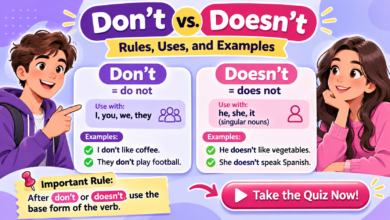
Don’t and doesn’t are short forms of:
- Don’t = Do not
- Doesn’t = Does not
We use them to say that something does not happen, that someone does not do something regularly, or that a fact is not true.
Let’s look at some examples:
- I don’t like coffee.
- She doesn’t play tennis.
- They don’t live in London.
- He doesn’t speak French.
Notice that all these sentences express a negative idea.
2. When Do We Use DON’T?
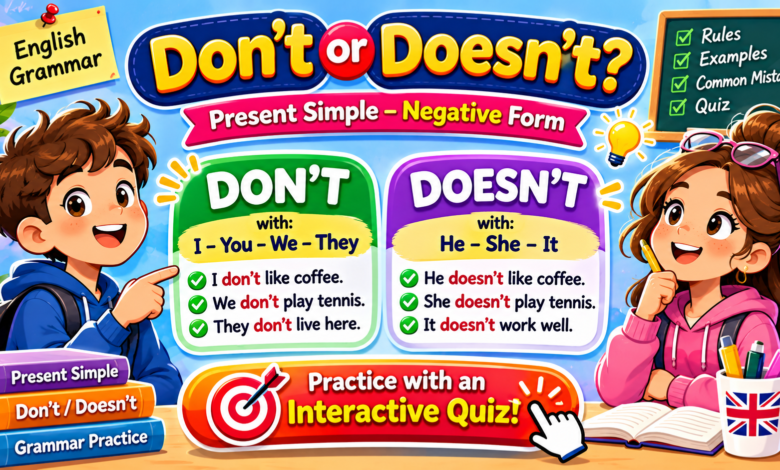
We use DON’T with the following subjects:
I – YOU – WE – THEY
We also use don’t with plural nouns, such as my parents, the children, the students and my friends.
Grammar Rule
Subject + DON’T + base form of the verb + complement.
| Subject | Example |
|---|---|
| I | I don’t like coffee. |
| You | You don’t understand me. |
| We | We don’t watch TV every day. |
| They | They don’t play football. |
| My friends | My friends don’t live here. |
| The students | The students don’t speak German. |
More Examples
- I don’t eat meat.
- You don’t need a new phone.
- We don’t go to school on Sundays.
- They don’t work at weekends.
- My brothers don’t drink milk.
💡 Remember: After DON’T, always use the base form of the verb.
For example:
- ✅ They don’t play football.
- ❌ They don’t plays football.
3. When Do We Use DOESN’T?
We use DOESN’T with these subjects:
HE – SHE – IT
We also use doesn’t with singular names and singular nouns, such as Ahmed, my mother, the teacher, the dog and my brother.
Grammar Rule
Subject + DOESN’T + base form of the verb + complement.
| Subject | Example |
|---|---|
| He | He doesn’t like coffee. |
| She | She doesn’t play tennis. |
| It | It doesn’t work properly. |
| Ahmed | Ahmed doesn’t speak Spanish. |
| My mother | My mother doesn’t drive. |
| The dog | The dog doesn’t eat vegetables. |
More Examples
- He doesn’t watch television.
- She doesn’t live in Paris.
- My father doesn’t work on Sundays.
- The cat doesn’t drink milk.
- Sarah doesn’t study Japanese.
💡 Remember: After DOESN’T, use the base form of the verb. Do not add -s or -es to the main verb.
For example:
- ✅ She doesn’t like pizza.
- ❌ She doesn’t likes pizza.
Why? Because the third-person singular marker is already carried by DOES in the negative form. The main verb returns to its base form.
4. DON’T vs DOESN’T: What’s the Difference?
The most important difference is the subject.
| DON’T | DOESN’T |
|---|---|
| I don’t | He doesn’t |
| You don’t | She doesn’t |
| We don’t | It doesn’t |
| They don’t | Ahmed doesn’t |
| My parents don’t | My mother doesn’t |
| The children don’t | The child doesn’t |
An Easy Way to Remember
Think of this simple rule:
🟢 DON’T: I, You, We, They
🔵 DOESN’T: He, She, It
Remember this rule, and you’ll avoid most mistakes!
5. Common Mistakes to Avoid
Many learners confuse don’t and doesn’t or forget to use the base form of the main verb.
Here are some common mistakes and their corrections:
| Incorrect ❌ | Correct ✅ |
|---|---|
| He don’t like milk. | He doesn’t like milk. |
| She don’t play tennis. | She doesn’t play tennis. |
| They doesn’t work here. | They don’t work here. |
| I doesn’t understand. | I don’t understand. |
| He doesn’t likes football. | He doesn’t like football. |
| She doesn’t goes to school. | She doesn’t go to school. |
| My parents doesn’t drive. | My parents don’t drive. |
Three Important Rules
- Never use DOESN’T with I, you, we or they.
- Never use DON’T with he, she or it in standard English.
- Always use the base form of the main verb after don’t and doesn’t.
6. What About Names and Nouns?
Sometimes, the subject is not a pronoun. It can be a person’s name, an animal, an object or a group of people.
The important thing is to identify whether the subject is singular or plural.
Singular subject → DOESN’T
- Mary doesn’t like chocolate.
- My brother doesn’t swim.
- The baby doesn’t sleep early.
- The computer doesn’t work.
Plural subject → DON’T
- Mary and John don’t like chocolate.
- My brothers don’t swim.
- The babies don’t sleep early.
- The computers don’t work.
Remember: One person, animal or thing generally takes DOESN’T, while plural subjects take DON’T.
7. Quick Grammar Summary
Let’s review everything we’ve learned!
| Subject | Negative Form | Example |
|---|---|---|
| I | don’t | I don’t sing. |
| You | don’t | You don’t sing. |
| He | doesn’t | He doesn’t sing. |
| She | doesn’t | She doesn’t sing. |
| It | doesn’t | It doesn’t work. |
| We | don’t | We don’t sing. |
| They | don’t | They don’t sing. |
The golden rule:
- DON’T + base verb
- DOESN’T + base verb
That’s it! Once you remember the subject groups, choosing the correct form becomes much easier.
8. Time to Test Your English! 🎮
You’ve learned the rules, explored examples and discovered the most common mistakes. But can you choose between DON’T and DOESN’T correctly?
It’s time to put your knowledge to the test!
Try our interactive DON’T or DOESN’T Grammar Quiz and challenge yourself with 20 questions.
🌟 What can you expect?
- 20 questions to test your grammar knowledge.
- Randomized questions and answer choices.
- Instant feedback after every answer.
- Clear explanations to help you learn from your mistakes.
- A live scoreboard showing your correct and incorrect answers.
- A final score to measure your progress!
🏆 Can you become a grammar champion and achieve a perfect score?
Don’t wait! Click the START QUIZ button below and see how well you know the difference between DON’T and DOESN’T!
Good luck, and have fun learning English! 🚀