There Is vs. There Are: Rules, Differences, and Examples in English Grammar
Do you know when to use there is and there are in English? These two expressions are commonly used to talk about people, places, objects, and things that exist. Although they look similar, choosing the correct form depends on whether the noun is singular, plural, or uncountable.
In this English grammar lesson, you’ll learn the difference between there is and there are, discover the main grammar rules, and practise with simple examples.
1. What Does “There Is” Mean?
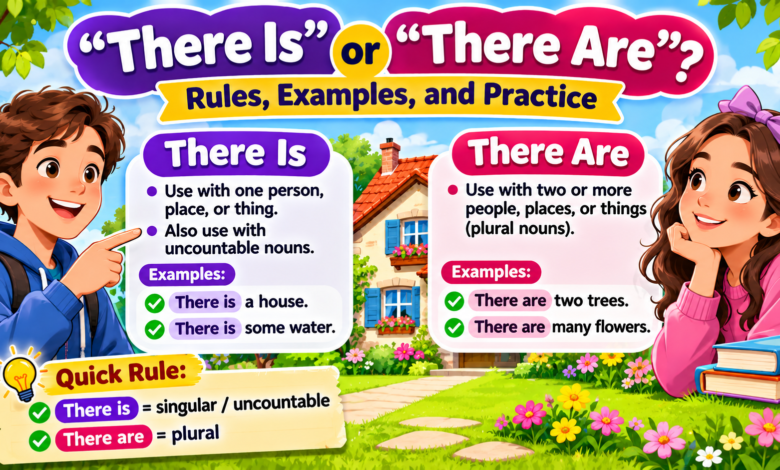
We use there is to talk about the existence or presence of one person, place, animal, or thing. It is followed by a singular noun or an uncountable noun.
Examples:
- There is a book on the table.
- There is a cat under the chair.
- There is a supermarket near my house.
- There is an apple in the basket.
- There is a beautiful garden behind the school.
In these examples, we use there is because we are talking about one person or thing.
There Is with Uncountable Nouns
We also use there is with uncountable nouns, such as water, milk, sugar, rice, and money.
Examples:
- There is some water in the bottle.
- There is milk in the fridge.
- There is a little sugar in my coffee.
- There is some rice on the plate.
Remember: Uncountable nouns are generally treated as singular in this structure.
2. What Does “There Are” Mean?
We use there are to talk about the existence or presence of two or more people, animals, places, or things.
It is followed by a plural noun.
Examples:
- There are three books on the table.
- There are two cats in the garden.
- There are many students in the classroom.
- There are five apples in the basket.
- There are some beautiful flowers in the park.
In these examples, we use there are because the nouns are plural.
3. The Main Difference Between There Is and There Are
The easiest way to remember the difference is to look at the noun that follows the expression.
| There Is | There Are |
|---|---|
| One book | Three books |
| A student | Ten students |
| An orange | Two oranges |
| A car | Many cars |
| Some water | Not used for this meaning |
Simple rule:
- THERE IS → Singular nouns and uncountable nouns.
- THERE ARE → Plural nouns.
4. There Is and There Are in Everyday Situations
We use these expressions frequently when describing places, rooms, cities, and everyday situations.
Describing a bedroom:
- There is a bed next to the window.
- There is a lamp on the desk.
- There are two pillows on the bed.
- There are some clothes in the wardrobe.
Describing a city:
- There is a beautiful mosque in the city.
- There are many restaurants near the beach.
- There is a large park in the centre.
- There are several schools in this neighbourhood.
Talking about food:
- There is some cheese in the fridge.
- There are four eggs in the basket.
- There is a bottle of juice on the table.
5. How to Make Negative Sentences
We can also use there is and there are to make negative sentences.
Simply add not after is or are.
There Is Not (There Isn’t)
Use there isn’t when something singular or uncountable does not exist or is not present.
Examples:
- There isn’t a TV in my bedroom.
- There isn’t any milk in the fridge.
- There isn’t a supermarket near my house.
There Are Not (There Aren’t)
Use there aren’t when talking about things that do not exist or are not present in the plural.
Examples:
- There aren’t any students in the classroom.
- There aren’t many cars in the street.
- There aren’t any apples in the basket.
6. Common Mistakes to Avoid
Many English learners confuse there is and there are. Here are some common mistakes and their corrections.
| Incorrect ❌ | Correct ✅ |
|---|---|
| There are a cat. | There is a cat. |
| There is two books. | There are two books. |
| There are an apple. | There is an apple. |
| There is many students. | There are many students. |
| There are some water. | There is some water. |
Important tip: Always check whether the noun is singular, plural, or uncountable before choosing your answer.
7. Quick Grammar Summary
Let’s review the most important rules:
- There is: Use with one person or thing.
- There is: Also use with uncountable nouns.
- There are: Use with two or more people or things.
- There isn’t: Negative form of there is.
- There aren’t: Negative form of there are.
Ready to Test Your Knowledge? 🎯
Now that you’ve learned the difference between there is and there are, it’s time to put your knowledge into practice!
Take the interactive “There Is” or “There Are” English Grammar Quiz below.
You’ll answer 20 questions, receive instant feedback, check your progress, and discover how well you’ve mastered this important English grammar rule.
Don’t just read the rules — practise them!
Start the quiz below and challenge yourself today! 🚀