First Conditional in English: Rules, Structure, Examples & Interactive Quiz
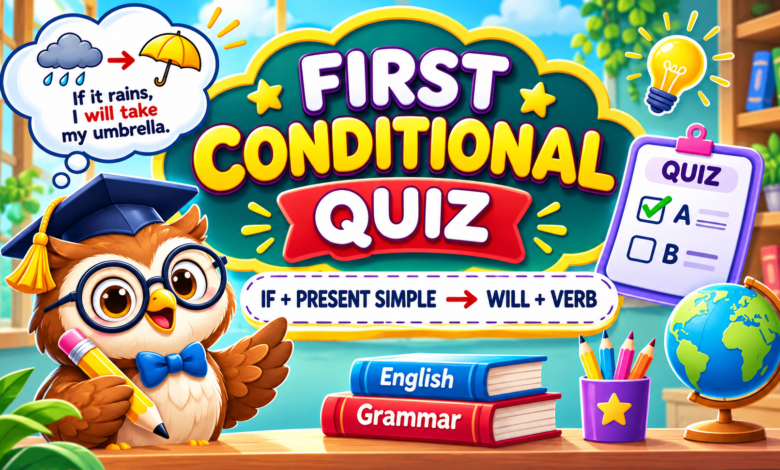
The First Conditional is an important English grammar structure used to talk about possible future situations and their likely results. We use it when we believe that something may happen in the future if a particular condition is fulfilled.
In this lesson, you will learn how to form the First Conditional, understand when to use it, explore practical examples, and avoid common grammatical mistakes. After studying the explanation, test your knowledge with our interactive First Conditional quiz.
1. What Is the First Conditional?
We use the First Conditional to describe a real or possible situation in the future and its expected consequence.
The condition may or may not happen, but the result is considered possible or likely.
Examples:
- If it rains tomorrow, I will stay at home.
- If you study hard, you will pass the exam.
- If she arrives early, we will go shopping.
- If they invite me, I will attend the party.
In these examples, the future result depends on a possible condition.
2. First Conditional Structure
The basic structure of the First Conditional is:
IF + PRESENT SIMPLE, WILL + BASE FORM OF THE VERB
The sentence contains two parts:
- If-clause: Describes the possible condition using the Present Simple.
- Main clause: Describes the expected result using will + the base form of the verb.
Structure:
If + subject + present simple, subject + will + base verb.
Examples:
| If-clause | Main clause |
|---|---|
| If I study hard, | I will pass the exam. |
| If it rains, | we will stay inside. |
| If he works hard, | he will succeed. |
| If you hurry, | you will catch the bus. |
Important: We normally do not use will in the if-clause when expressing an ordinary future condition.
Correct: If I see John, I will tell him.
Incorrect: If I will see John, I will tell him.
3. First Conditional Examples in Everyday Situations
Here are some practical examples to help you understand how we use this structure in everyday English.
Weather:
- If the weather is sunny tomorrow, we will go to the beach.
- If it snows tonight, the children will build a snowman.
School and Education:
- If you revise your lessons, you will get good marks.
- If the teacher gives us homework, I will finish it tonight.
Daily Life:
- If I have enough money, I will buy a new laptop.
- If my mother cooks dinner, I will help her.
Travel:
- If we leave early, we will arrive on time.
- If they miss the train, they will take a taxi.
Health and Fitness:
- If you exercise regularly, you will feel better.
- If he eats too much sugar, he will gain weight.
4. Using the First Conditional with Negative Sentences
We can also use negative forms in the First Conditional.
The negative form of will is will not or won’t.
Examples:
- If you don’t study, you won’t pass the exam.
- If it doesn’t rain, we will play football.
- If she doesn’t hurry, she will miss the bus.
- If they don’t leave now, they won’t arrive on time.
Remember that don’t and doesn’t are used to form the Present Simple negative in the if-clause.
5. First Conditional Questions
We can use the First Conditional to ask questions about possible future situations.
Examples:
- What will you do if you miss the bus?
- Will you come to the party if I invite you?
- Where will they stay if they visit London?
- What will happen if we don’t follow the instructions?
These questions help us discuss possible future events and their consequences.
6. Common First Conditional Mistakes
English learners sometimes make mistakes when forming First Conditional sentences. Here are some common errors and their corrections.
Mistake 1: Using will in the if-clause
Incorrect: If I will have time, I will visit you.
Correct: If I have time, I will visit you.
Explanation: Use the Present Simple in the if-clause, not will.
Mistake 2: Using the wrong verb form after will
Incorrect: If she studies, she will passes the exam.
Correct: If she studies, she will pass the exam.
Explanation: Always use the base form of the verb after will.
Mistake 3: Forgetting the third-person singular -s
Incorrect: If he study hard, he will succeed.
Correct: If he studies hard, he will succeed.
Explanation: In the Present Simple, add -s or -es to the verb when the subject is he, she, or it.
Mistake 4: Confusing the First Conditional with the Second Conditional
Incorrect: If I have enough money, I would buy a car. (when expressing an ordinary real future possibility)
Correct: If I have enough money, I will buy a car.
Explanation: The First Conditional is generally used for real or possible future situations. The Second Conditional is commonly used for hypothetical or less likely situations.
7. Important Tips to Remember
Before taking the quiz, remember these essential rules:
- Use the Present Simple in the if-clause.
- Use will + the base form of the verb in the main clause.
- Do not normally use will directly after if in ordinary First Conditional sentences.
- Use won’t as the negative form of will.
- You can place the if-clause at the beginning or end of the sentence.
Punctuation tip:
When the if-clause comes first, use a comma between the two clauses.
Example: If it rains, we will stay home.
When the main clause comes first, a comma is usually unnecessary.
Example: We will stay home if it rains.
8. Test Your Knowledge: First Conditional Interactive Quiz
Now that you have studied the rules, examples, and common mistakes, it is time to check your understanding!
Take our interactive quiz and practise forming First Conditional sentences. Read each question carefully, choose the correct answer, and check your results.
Ready to begin?
Click the button below to start the First Conditional quiz.
Good luck, and keep practising your English!


Yazınız için teşekkürler. Bu bilgiler ışığında nice insanlar bilgilenmiş olacaktır.
I really like reading through a post that can make men and women think. Also, thank you for allowing me to comment!
Pretty! This has been a really wonderful post. Many thanks for providing these details.
Pretty! This has been a really wonderful post. Many thanks for providing these details.
I truly appreciate your technique of writing a blog. I added it to my bookmark site list and will
Thanks I have just been looking for information about this subject for a long time and yours is the best Ive discovered till now However what in regards to the bottom line Are you certain in regards to the supply
The article gave me a better understanding of the things I should pay attention to. I am glad I found this website and will stop by again.
I found the overall discussion balanced and full of practical observations. Keep publishing content like this because it really helps curious readers.
I found this page through a search result and decided to read the entire article. Thank you for making the information welcoming for beginners.