The Verb To Be in the Present Simple: Affirmative, Negative and Interrogative Forms
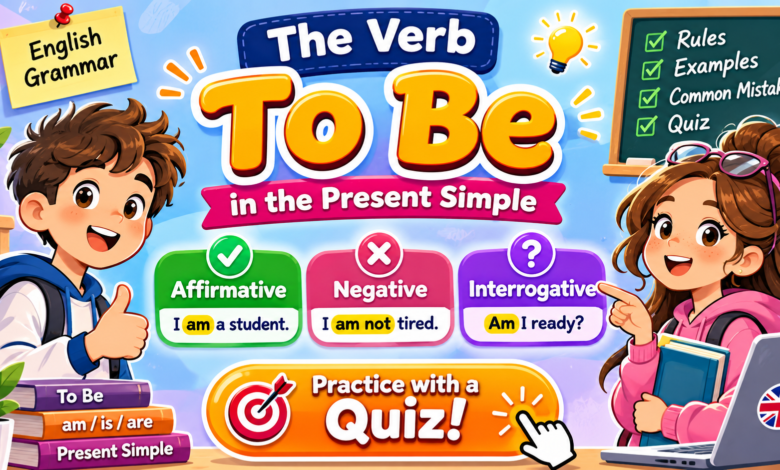
The verb “to be” in the Present Simple is one of the most important grammar topics for English beginners. It is used to talk about people’s names, ages, jobs, nationalities, feelings, locations and descriptions.
In the present simple, the verb to be has three forms: am, is and are. Understanding how to use these forms in affirmative sentences, negative sentences and questions will help you build correct English sentences and communicate more confidently.
In this lesson, you will learn how to use am, is and are in all three forms, with simple explanations and useful examples.
1. The Verb To Be: Present Simple
The verb “to be” changes depending on the subject of the sentence.
Here is a simple table showing which form to use:
| Subject | Verb To Be | Example |
|---|---|---|
| I | am | I am a student. |
| He | is | He is a teacher. |
| She | is | She is happy. |
| It | is | It is a beautiful day. |
| You | are | You are my friend. |
| We | are | We are ready. |
| They | are | They are at school. |
Remember:
- Use AM with I.
- Use IS with he, she and it.
- Use ARE with you, we and they.
2. The Affirmative Form
We use the affirmative form to give positive information about someone or something.
Structure
Subject + am / is / are + complement.
Examples:
- I am 15 years old.
- She is a doctor.
- He is very friendly.
- We are students.
- They are from Morocco.
- The classroom is clean.
Short Forms (Contractions)
In everyday English, we often use contractions to make sentences shorter.
| Full Form | Short Form |
|---|---|
| I am | I’m |
| He is | He’s |
| She is | She’s |
| It is | It’s |
| You are | You’re |
| We are | We’re |
| They are | They’re |
Examples:
- I’m a student.
- She’s my sister.
- They’re happy.
Both full forms and short forms are correct.
3. The Negative Form
We use the negative form when we want to say that something is not true or does not describe someone or something.
To make a negative sentence, simply add not after am, is or are.
Structure
Subject + am / is / are + not + complement.
Examples:
- I am not tired.
- He is not a doctor.
- She is not at home.
- We are not late.
- They are not hungry.
Negative Contractions
We can also use contracted forms:
| Full Form | Short Form |
|---|---|
| I am not | I’m not |
| He is not | He isn’t |
| She is not | She isn’t |
| It is not | It isn’t |
| You are not | You aren’t |
| We are not | We aren’t |
| They are not | They aren’t |
Examples:
- I’m not angry.
- He isn’t my brother.
- We aren’t ready.
- They aren’t at school.
Important: We say “I am not” or “I’m not”. We do not normally use “I amn’t” in standard English.
4. The Interrogative Form
We use the interrogative form to ask questions.
To make a question with the verb “to be”, we change the order of the subject and the verb.
The verb comes before the subject.
Structure
Am / Is / Are + subject + complement + ?
Examples:
- Am I late?
- Is he your brother?
- Is she a teacher?
- Are you happy?
- Are they students?
- Are we ready?
Notice how the verb moves to the beginning of the sentence.
Short Answers
We can answer questions using short answers with the verb “to be”.
| Question | Positive Answer | Negative Answer |
|---|---|---|
| Are you a student? | Yes, I am. | No, I’m not. |
| Is she happy? | Yes, she is. | No, she isn’t. |
| Is he a doctor? | Yes, he is. | No, he isn’t. |
| Are they friends? | Yes, they are. | No, they aren’t. |
| Are we late? | Yes, we are. | No, we aren’t. |
Remember: In short answers, we usually do not use contractions in positive answers. For example, say “Yes, I am”, not “Yes, I’m”.
5. Common Mistakes to Avoid
Many English learners make mistakes when using the verb “to be”. Here are some common errors and their corrections.
| Incorrect Sentence | Correct Sentence |
|---|---|
| I is a student. | I am a student. |
| She are happy. | She is happy. |
| They is friends. | They are friends. |
| He not is tired. | He is not tired. |
| You are not a teacher? | Are you a teacher? |
| Does she be happy? | Is she happy? |
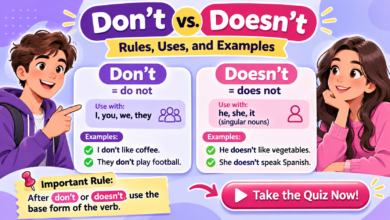
Important grammar tip: Do not use do or does to form ordinary present simple questions or negatives with the verb “to be”. Use am, is or are directly.
6. Quick Summary: The Three Forms
Let’s review the three forms of the verb “to be” in the Present Simple.
| Form | Structure | Example |
|---|---|---|
| Affirmative | Subject + am/is/are | She is happy. |
| Negative | Subject + am/is/are + not | She is not happy. |
| Interrogative | Am/Is/Are + subject? | Is she happy? |
Remember these three basic rules:
- ✅ Affirmative: I am happy.
- 🚫 Negative: I am not happy.
- ❓ Interrogative: Am I happy?
Learning these structures will help you form correct sentences and ask simple questions in English.
7. Test Your Knowledge! 🎯
Now that you have learned how to use the verb “to be” in the Present Simple, it’s time to put your knowledge into practice!
Challenge yourself with our interactive Verb To Be Quiz, covering the affirmative, negative and interrogative forms.
Answer the questions, receive instant feedback, discover your mistakes and check your final score. You can also review the grammar explanations to improve your understanding.
Ready to see how much you’ve learned?
👇 Click the START QUIZ button below and test your English grammar skills. Good luck!