Before and After in English: Rules, Examples, and Exercises
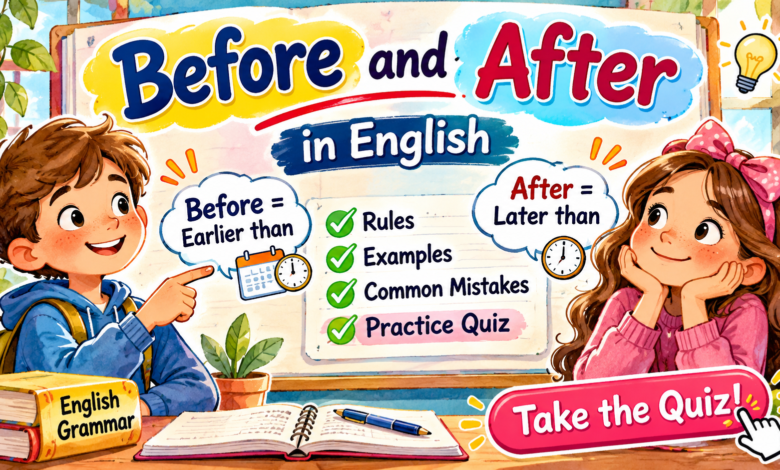
Learning how to use before and after correctly is an important part of improving your English grammar. These two time expressions help us explain when actions happen and describe the order of events.
Whether you are an English beginner or looking to improve your writing and speaking skills, understanding the difference between before and after will help you build clearer and more accurate sentences.
In this lesson, you will learn the rules for using before and after, explore simple examples, discover useful expressions, and practise what you have learned.
1. When Do We Use BEFORE?
We use before to talk about something that happens earlier than another action or event.
In simple words:
BEFORE = Earlier than something else.
Examples:
- Wash your hands before you eat.
- I always brush my teeth before going to bed.
- Look both ways before you cross the street.
- She arrived before me.
- Please finish your homework before dinner.
In these examples, the first action happens earlier than the second one.
2. When Do We Use AFTER?
We use after to talk about something that happens later than another action or event.
In simple words:
AFTER = Later than something else.
Examples:
- I watched TV after finishing my homework.
- She felt better after taking the medicine.
- We went home after the film.
- After the meeting ended, everyone left.
- I usually play football after school.
Remember: the action following after happens later than the action mentioned before it.
3. BEFORE and AFTER + Verb-ing
Both before and after can be followed by a verb ending in -ing.
Examples:
| BEFORE + verb-ing | AFTER + verb-ing |
|---|---|
| Before going to bed, I read. | After eating, I washed the dishes. |
| Wash your hands before eating. | He watched TV after finishing homework. |
| Think before speaking. | After watching the film, we discussed it. |
Remember: When a verb comes directly after before or after, we commonly use the -ing form.
4. BEFORE and AFTER + a Full Sentence
We can also use before and after followed by a subject and a verb.
Examples:
- Look both ways before you cross the street.
- Turn off the lights before you leave.
- I called my friend after I finished my homework.
- She sent a message after the meeting ended.
These structures are useful when we want to describe the order of two complete actions.
Important Grammar Rule: Talking About the Future
When before and after introduce a future time clause, we normally use the present simple, not will.
Correct:
- I will call you after I arrive.
- She will start cooking before her guests come.
Incorrect:
- I will call you after I will arrive.
- She will start cooking before her guests will come.
Even though the actions refer to the future, the verb after before or after is normally in the present simple.
5. Useful Expressions with BEFORE and AFTER
Here are some common expressions that you should remember:
Before long = Soon.
Example: Before long, the rain stopped.
After all = Used to add a reason, explanation, or reminder.
Example: After all, everyone makes mistakes.
The day before yesterday = Two days ago.
Example: The day before yesterday, we visited the museum.
The day after tomorrow = Two days from today.
Example: The day after tomorrow, I will visit my grandparents.
Have you ever…? Before = At an earlier time.
Example: Have you ever visited London before?
6. Before vs. After: Quick Comparison
| BEFORE | AFTER |
|---|---|
| Earlier than an event | Later than an event |
| Before lunch | After lunch |
| Before going out | After going out |
| Before I sleep | After I wake up |
| Before the lesson | After the lesson |
Easy trick to remember:
⏪ BEFORE: First action.
⏩ AFTER: Later action.
7. Common Mistakes to Avoid
Here are some mistakes English learners should avoid:
❌ I will call you after I will arrive.
✅ I will call you after I arrive.
❌ Before go to school, I eat breakfast.
✅ Before going to school, I eat breakfast.
❌ After finish my homework, I play football.
✅ After finishing my homework, I play football.
Pay attention to the verb forms and the order of events to avoid these common mistakes.
8. Test Your Knowledge: Before and After Quiz
Now that you have learned the rules, it is time to put your knowledge into practice!
The best way to master English grammar is through regular practice. Try completing the interactive quiz below and see how well you understand the difference between before and after.
🎯 What does the quiz include?
- 20 multiple-choice questions.
- Two answer choices for each question.
- A variety of everyday situations and sentence structures.
- Instant feedback with explanations.
- A live scoreboard to track your progress.
- A final score showing your performance.
- A review section to help you learn from your mistakes.
🌟 Are you ready for the challenge?
Scroll down, start the quiz, choose the correct answers, and discover how well you can use BEFORE and AFTER!
Good luck, and enjoy learning English! 🚀