Prepositions of Place in English: 22 Essential Prepositions with Examples
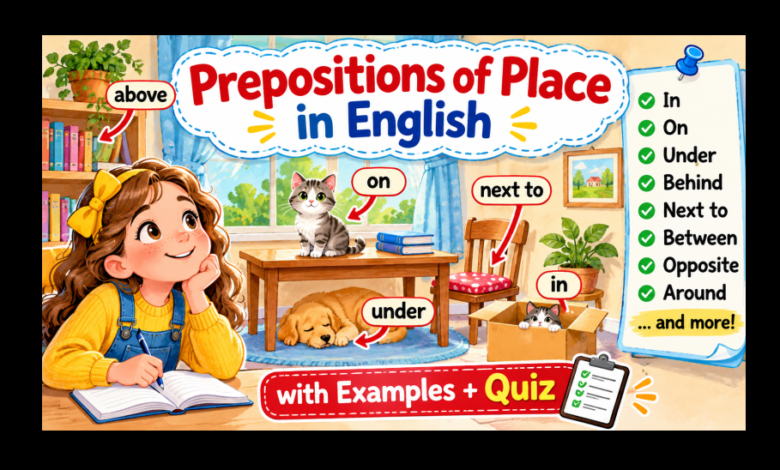
Learning prepositions of place is an important part of mastering English grammar. These useful words and expressions help us describe where people, animals, objects, and places are located. Whether you are talking about things in your classroom, describing your bedroom, or giving someone directions, prepositions of place make your sentences clearer and more meaningful.
In this lesson, you will discover 22 common prepositions of place, learn how to use them correctly, and explore simple examples to improve your English vocabulary and grammar.
📍 What Are Prepositions of Place?
Prepositions of place are words or expressions that tell us where something or someone is located. They describe the position of an object in relation to another object, person, or place.
For example:
- The book is on the desk.
- The cat is under the chair.
- The teacher is in front of the board.
- The school is near the park.
These prepositions help us answer the question: Where is it?
📚 22 Common Prepositions of Place with Examples
Let’s explore the most useful prepositions of place and see how to use each one in everyday English.
1. IN
We use in when something is inside an enclosed space or area.
- The pencils are in the pencil case.
- My mother is in the kitchen.
2. ON
We use on when something is touching the surface of another object.
- The book is on the table.
- There is a picture on the wall.
3. UNDER
We use under when something is directly below another object.
- The cat is under the bed.
- My shoes are under the chair.
4. ABOVE
We use above when something is at a higher position than another thing, without necessarily being directly over it.
- The clock is above the door.
- The picture is above the sofa.
5. BELOW
We use below when something is at a lower level or position than another thing.
- The temperature is below zero.
- The shelf is below the window.
6. BEHIND
We use behind when something is at the back of another object or person.
- The garden is behind the house.
- The boy is behind the tree.
7. IN FRONT OF
We use in front of when something is positioned before another object or person.
- The teacher is in front of the students.
- The car is in front of the house.
8. NEXT TO
We use next to when something is immediately beside another object or person.
- Sarah is sitting next to her best friend.
- The bank is next to the supermarket.
9. BETWEEN
We use between when something or someone is in the middle of two people or things.
- The ball is between the two boxes.
- The school is between the bank and the post office.
10. NEAR
We use near when something is not far away from another place or object.
- My house is near the school.
- There is a supermarket near our home.
11. FAR FROM
We use far from when something is at a great distance from another place.
- The airport is far from the city centre.
- My village is far from the beach.
12. OPPOSITE
We use opposite when something is facing or located across from another place or object.
- The pharmacy is opposite the hospital.
- Our classroom is opposite the library.
13. BESIDE
We use beside to describe something located at the side of another object or person. It has almost the same meaning as next to.
- The girl is sitting beside her mother.
- The lamp is beside the bed.
14. INSIDE
We use inside when something is within the interior of a place, container, or object.
- The children are inside the classroom.
- There is a gift inside the box.
15. OUTSIDE
We use outside when something or someone is not inside a building or enclosed area.
- The children are playing outside the house.
- My bicycle is outside the garage.
16. OVER
We use over when something is directly above another thing, often with the idea of covering or crossing it.
- The plane is flying over the city.
- She put a blanket over the baby.
17. AMONG
We use among when someone or something is surrounded by or positioned within a group of people or things.
- The teacher is standing among the students.
- I found my pencil among the books.
18. AROUND
We use around when something is surrounding another thing or located on different sides of it.
- There are trees around the house.
- The children are sitting around the table.
19. AT
We use at to refer to a particular point or location.
- My father is at work.
- The students are at school.
20. BY
We use by to mean beside or close to something.
- The girl is sitting by the window.
- There is a small table by the sofa.
21. TO THE LEFT OF
We use to the left of to describe something positioned on the left-hand side of another object or place.
- The library is to the left of the school.
- The lamp is to the left of the television.
22. TO THE RIGHT OF
We use to the right of to describe something positioned on the right-hand side of another object or place.
- The supermarket is to the right of the bank.
- The chair is to the right of the desk.
💡 Important Differences Between Prepositions of Place
Some prepositions of place have similar meanings, but they are not always interchangeable. Here are a few useful differences to remember:
1. In vs. On
- The books are in the bag. (Inside the bag.)
- The books are on the bag. (On its surface.)
2. Under vs. Below
- The cat is under the table. (Directly beneath it.)
- The temperature is below zero. (At a lower level.)
3. Above vs. Over
- The picture is above the sofa. (At a higher position.)
- The plane is flying over the city. (Passing across a place.)
4. Next to vs. Near
- The bank is next to the supermarket. (Immediately beside it.)
- The bank is near the supermarket. (Close to it, but not necessarily beside it.)
5. Between vs. Among
- The boy is between two girls. (In the middle of two people.)
- The boy is among his classmates. (Within a group.)
6. Behind vs. In front of
- The car is behind the house.
- The car is in front of the house.
These small differences will help you choose the correct preposition in different situations.
🎯 Why Are Prepositions of Place Important?
Prepositions of place are used in everyday communication. They help you:
- Describe the location of objects in a room.
- Talk about people and their positions.
- Give and understand directions.
- Describe places and surroundings.
- Build accurate and meaningful English sentences.
The best way to master these prepositions is to practise using them in real-life situations.
📝 Test Your Knowledge!
Now that you have learned 22 essential prepositions of place, it is time to check how well you understand them!
Are you ready to put your knowledge into practice? Challenge yourself, complete the sentences, and choose the correct prepositions to describe different locations.
🚀 Click the START QUIZ button below to begin the quiz and test your knowledge of prepositions of place! Good luck!