The Verb To Have: How to Use Has and Have in English
The verb to have is one of the most important verbs in the English language. We use it every day to talk about possessions, family relationships, physical characteristics, and many other things.
However, English learners sometimes confuse has and have. Which one should we use with he, she, and it? Should we say She have a sister or She has a sister?
In this lesson, you will learn the difference between has and have, understand their grammatical rules, and practise using them correctly in everyday sentences.
1. What Does the Verb “To Have” Mean?
The verb to have commonly expresses possession. It tells us that someone owns, possesses, or has something.
For example:
- I have a new phone.
- Sarah has a beautiful dress.
- They have two children.
- My teacher has a laptop.
We can also use have to talk about relationships, physical characteristics, and everyday things.
Examples:
- I have two brothers. (Family relationship)
- She has blue eyes. (Physical characteristic)
- We have a big house. (Possession)
- They have breakfast at 8 o’clock. (Daily routine)
2. When Do We Use HAVE?
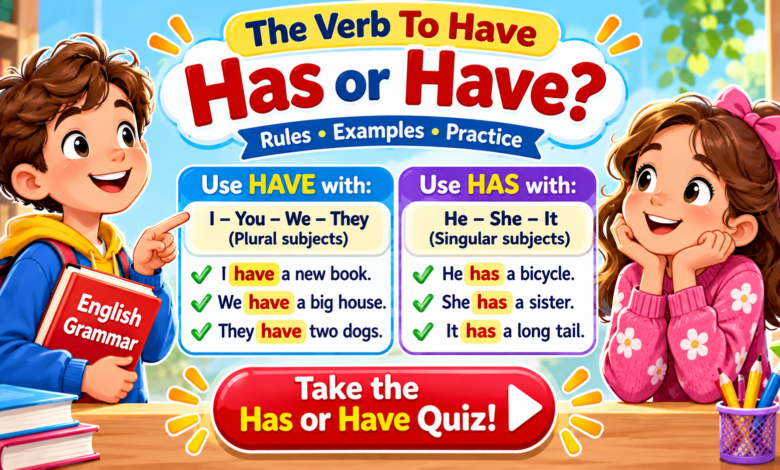
We use have with the following subjects:
- I
- You
- We
- They
- Plural nouns
Examples:
| Subject | Example |
|---|---|
| I | I have a new schoolbag. |
| You | You have a beautiful garden. |
| We | We have English books. |
| They | They have two dogs. |
| My friends | My friends have a football. |
| The children | The children have many toys. |
Remember: Use have with plural subjects, even when the subject is a noun rather than a pronoun.
For example:
- The students have new books.
- My parents have a new car.
3. When Do We Use HAS?
We use has with third-person singular subjects:
- He
- She
- It
- Singular nouns (one person, animal, or thing)
Examples:
| Subject | Example |
|---|---|
| He | He has a new bicycle. |
| She | She has a little brother. |
| It | It has a long tail. |
| My father | My father has a blue car. |
| The cat | The cat has green eyes. |
| Sarah | Sarah has a beautiful dress. |
Important rule: When the subject is he, she, it, or a singular noun, use has, not have.
4. Has vs Have: The Main Difference
The easiest way to remember the difference is to look at the subject of the sentence.
| HAVE | HAS |
|---|---|
| I have | He has |
| You have | She has |
| We have | It has |
| They have | Ali has |
| My friends have | The dog has |
Let’s look at some more examples:
- I have a computer, but my brother has a tablet.
- We have a large garden, but our neighbour has a small one.
- They have three cats, but Sarah has only one.
- You have a new bag, and he has a new schoolbag.
5. How to Make Negative Sentences
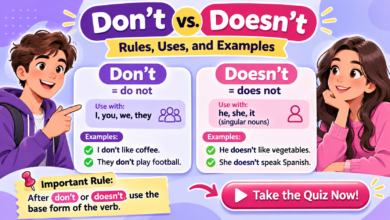
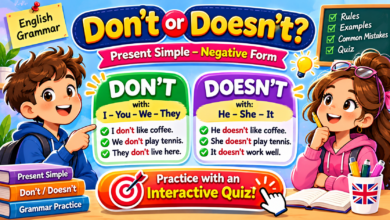
To make negative sentences in the simple present, we usually use do not (don’t) or does not (doesn’t) before the base form have.
With I, You, We, and They
Use:
Subject + don’t + have + object
Examples:
- I don’t have a car.
- You don’t have a pencil.
- We don’t have enough time.
- They don’t have a television.
With He, She, and It
Use:
Subject + doesn’t + have + object
Examples:
- He doesn’t have a bicycle.
- She doesn’t have a brother.
- It doesn’t have a long tail.
⚠️ Common mistake:
Incorrect: She doesn’t has a car.
Correct: She doesn’t have a car.
Remember that after doesn’t, we always use the base form have, not has.
6. How to Ask Questions Using Have and Has
When we use the simple present, we form questions with Do or Does.
With I, You, We, and They
Do + subject + have + object?
Examples:
- Do you have a pet?
- Do they have a new teacher?
- Do we have homework today?
With He, She, and It
Does + subject + have + object?
Examples:
- Does he have a brother?
- Does she have a computer?
- Does your dog have a name?
⚠️ Remember: After does, use have, not has.
Incorrect: Does she has a sister?
Correct: Does she have a sister?
7. Common Mistakes with Has and Have
Here are some frequent mistakes English learners should avoid:
| Incorrect | Correct |
|---|---|
| She have a cat. | She has a cat. |
| He have a car. | He has a car. |
| They has a house. | They have a house. |
| My parents has a garden. | My parents have a garden. |
| She doesn’t has a phone. | She doesn’t have a phone. |
| Does he has a brother? | Does he have a brother? |
The most important thing to remember is:
- Use has with he, she, it, and singular nouns in affirmative simple-present sentences.
- Use have with I, you, we, they, and plural nouns.
- After does or doesn’t, always use have.
8. Quick Practice: Choose Has or Have
Test your understanding with these five sentences. Choose the correct answer in each one.
- My sister ______ a new bicycle.
- a) have
- b) has
- They ______ two beautiful dogs.
- a) has
- b) have
- He ______ a blue schoolbag.
- a) has
- b) have
- We ______ a lot of homework today.
- a) have
- b) has
- The little baby ______ blue eyes.
- a) have
- b) has
Answers: 1. has | 2. have | 3. has | 4. have | 5. has
9. Test Your Knowledge: Has or Have Quiz!
🎯 Now that you understand the difference between has and have, it’s time to put your knowledge into practice!
Take our interactive Has or Have English Grammar Quiz below. Read each sentence carefully, choose the correct answer, and check your progress as you go.
🏆 Challenge yourself, learn from your mistakes, and see how well you can use has and have in English!
Ready to begin? Scroll down and start the quiz below!