Adverbs of Frequency in English: Rules, Examples, and Exercises
Do you know how to say that you do something every day, sometimes, or almost never in English? To express how often an action happens, we use adverbs of frequency.
Adverbs of frequency are essential in everyday English conversations. They help us describe our habits, daily routines, and repeated activities.
In this easy English grammar guide, you will learn the most common adverbs of frequency, understand their meanings, discover where to place them in sentences, and practise using them through simple examples.
Let’s get started!
1. What Are Adverbs of Frequency?
Adverbs of frequency are words that tell us how often an action happens.
They answer the question: How often?
For example:
- I always brush my teeth.
- She usually gets up early.
- We sometimes watch television.
- He never drinks coffee.
In these sentences, the adverbs always, usually, sometimes, and never tell us how frequently the actions happen.
2. The Most Common Adverbs of Frequency
There are several adverbs of frequency in English. Some describe actions that happen very regularly, while others describe actions that happen only occasionally.
Here are the most commonly used ones.
1. Always
Meaning: 100% of the time. Something happens every time.
Examples:
- I always brush my teeth before bed.
- She always arrives at school on time.
- My father always drinks coffee in the morning.
2. Usually
Meaning: Most of the time. Something happens regularly, but not always.
Examples:
- I usually wake up at 7 a.m.
- He usually walks to school.
- We usually have dinner together.
3. Normally
Meaning: Under ordinary or usual circumstances.
Examples:
- I normally go to bed at 10 p.m.
- She normally takes the bus to work.
- We normally eat lunch at home.
4. Generally
Meaning: In most situations or most of the time.
Examples:
- Children generally enjoy playing games.
- I generally prefer tea to coffee.
- People generally feel happier after exercising.
5. Often
Meaning: Many times or frequently.
Examples:
- I often read books in the evening.
- She often visits her grandmother.
- They often play football after school.
6. Frequently
Meaning: Regularly or many times. It is similar to often.
Examples:
- He frequently travels for work.
- We frequently use computers at school.
- My teacher frequently gives us homework.
7. Sometimes
Meaning: On some occasions, but not always.
Examples:
- I sometimes eat pizza.
- She sometimes watches films.
- We sometimes go shopping on Sundays.
8. Occasionally
Meaning: Not very often, but from time to time.
Examples:
- I occasionally eat at restaurants.
- He occasionally plays tennis.
- They occasionally visit the countryside.
9. Rarely
Meaning: Not often. Something happens on very few occasions.
Examples:
- I rarely drink fizzy drinks.
- She rarely watches television.
- My brother rarely eats fast food.
10. Seldom
Meaning: Almost never or not often. It is similar to rarely and is slightly more formal.
Examples:
- He seldom goes to the cinema.
- We seldom eat out.
- She seldom makes mistakes.
11. Hardly Ever
Meaning: Almost never. Something happens very rarely.
Examples:
- I hardly ever drink coffee.
- She hardly ever misses a class.
- They hardly ever travel by plane.
12. Never
Meaning: 0% of the time. Something does not happen at any time.
Examples:
- I never smoke.
- He never arrives late.
- We never eat dinner after midnight.
3. Adverbs of Frequency: From Always to Never
The following frequency scale shows the approximate frequency associated with common adverbs.
| Adverb | Approximate frequency |
|---|---|
| Always | 100% |
| Usually | 90% |
| Normally | 80–90% |
| Generally | 80–90% |
| Often / Frequently | 70% |
| Sometimes | 50% |
| Occasionally | 30% |
| Seldom / Rarely | 10% |
| Hardly ever | 5% |
| Never | 0% |
Note: These percentages are approximate teaching guidelines, not fixed grammatical rules. Actual frequency depends on the speaker and context.
4. Where Do We Put Adverbs of Frequency in a Sentence?
One of the most important things to learn about adverbs of frequency is their position in a sentence.
There are three main rules to remember.
Rule 1: Before the Main Verb
We usually place adverbs of frequency before the main verb.
Examples:
- I always drink water.
- She usually walks to school.
- They often play football.
- He never eats vegetables.
Rule 2: After the Verb “To Be”
When using the verbs am, is, or are, we usually place the adverb of frequency after the verb.
Examples:
- I am always happy.
- She is usually busy.
- They are sometimes late.
- He is never angry.
Rule 3: After Auxiliary Verbs
When a sentence contains an auxiliary verb, the adverb of frequency usually comes after the first auxiliary verb.
Examples:
- I have never visited London.
- She can always help you.
- They don’t usually eat breakfast.
- He has often travelled abroad.
5. How to Ask Questions About Frequency
To ask someone how often they do something, we use the question phrase:
HOW OFTEN + AUXILIARY VERB + SUBJECT + MAIN VERB?
Examples:
- How often do you exercise?
- How often does she visit her grandmother?
- How often do they play football?
- How often do you go shopping?
We can answer using adverbs of frequency:
Example conversation:
A: How often do you play football?
B: I usually play football twice a week.
A: How often does your sister read books?
B: She often reads books in the evening.
We can also answer with expressions of frequency:
- Every day.
- Once a week.
- Twice a month.
- Three times a year.
- Every weekend.
6. Common Mistakes to Avoid
English learners sometimes make mistakes when using adverbs of frequency.
Here are some examples:
Mistake 1: Incorrect position with the verb “to be”.
❌ She always is happy.
✅ She is always happy.
Mistake 2: Incorrect position with the main verb.
❌ I go always to school by bus.
✅ I always go to school by bus.
Mistake 3: Using double negatives.
❌ I don’t never drink coffee.
✅ I never drink coffee.
Mistake 4: Confusing “sometimes” and “always”.
Remember that always means every time, while sometimes means only on some occasions.
7. Why Are Adverbs of Frequency Important?
Learning adverbs of frequency will help you communicate more naturally in English.
You can use them to:
- Talk about your daily routine.
- Describe your habits.
- Explain how often you do activities.
- Ask people about their lifestyles.
- Talk about things you rarely or never do.
For example:
“I usually wake up early. I always have breakfast before going to work, and I sometimes exercise in the evening. I rarely watch television, and I never go to bed without brushing my teeth.”
This short paragraph uses several adverbs of frequency to describe someone’s daily habits.
8. Test Your Knowledge: Adverbs of Frequency Quiz!
🌟 Now that you have learned the most common adverbs of frequency and how to use them in sentences, it’s time to put your knowledge to the test!
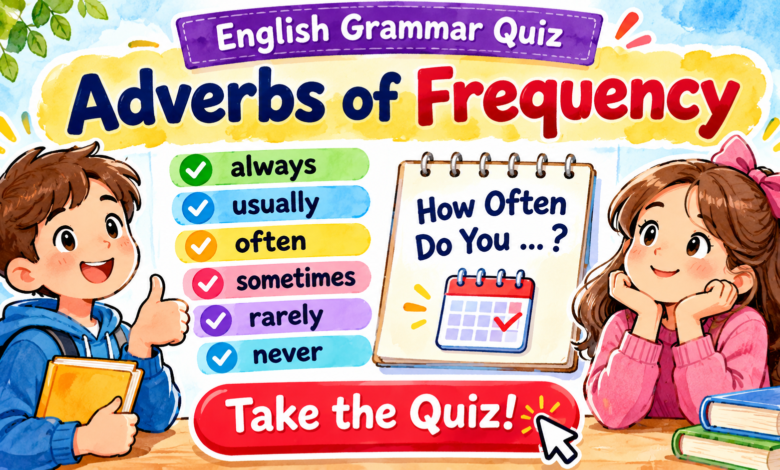
Can you choose between always, usually, often, sometimes, rarely, and never correctly?
Take our interactive Adverbs of Frequency English Grammar Quiz below!
📝 The quiz includes 20 multiple-choice questions, with only two answer choices for each question.
🎯 You will receive instant feedback, helpful explanations, and your final score when you finish.
Ready to challenge yourself? Start the quiz below and see how well you understand adverbs of frequency!