Punctuation Marks in English: Names, Uses, and Examples
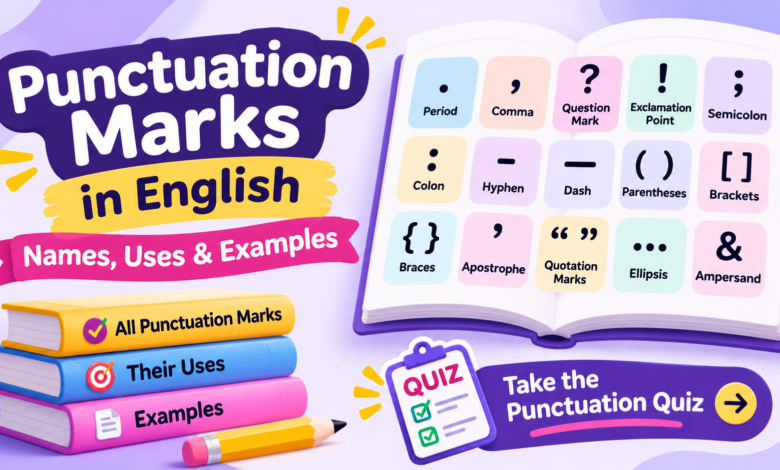
Punctuation marks are essential parts of written English. They help us organize sentences, express emotions, ask questions, separate ideas, and make our writing clear and easy to understand.
Whether you are a beginner learning English or a student improving your writing skills, understanding punctuation marks is an important step towards becoming a better writer.
But do you know the names of all the punctuation marks in English? Do you know the difference between a hyphen and a dash, or between a slash and a backslash?
In this guide, we will explore 22 common punctuation and writing symbols, explain their uses, and provide easy examples to help you understand them.
1. Period (.) – Full Stop
A period, also called a full stop, is used at the end of a statement or a sentence that expresses a complete thought.
Examples:
- I go to school every day.
- She loves reading books.
- My brother is a teacher.
2. Question Mark (?)
A question mark is placed at the end of a direct question. It shows that someone is asking something.
Examples:
- What is your name?
- Where do you live?
- Are you ready?
3. Exclamation Point (!)
An exclamation point, also called an exclamation mark, expresses strong emotions such as excitement, surprise, anger, or happiness.
Examples:
- What a beautiful day!
- Watch out!
- I won the competition!
4. Comma (,)
A comma is used to separate items in a list, introduce a pause, or separate certain parts of a sentence.
Examples:
- I bought apples, bananas, and oranges.
- After school, I went home.
- Yes, I can help you.
5. Semicolon (;)
A semicolon connects two closely related independent clauses. It can also separate complex items in a list.
Examples:
- I wanted to go outside; it was raining.
- Sarah likes reading; her brother prefers drawing.
6. Colon (:)
A colon introduces a list, an explanation, or a quotation.
Examples:
- I need three things: a pen, a notebook, and a ruler.
- She had one dream: to become a doctor.
- Remember this: practice makes perfect.
7. Hyphen (-)
A hyphen is a short horizontal line used to join words, especially in compound words and compound adjectives.
Examples:
- She is a five-year-old girl.
- This is a well-known story.
- My mother bought a sugar-free drink.
8. Dash (– or —)
A dash is a longer horizontal line used to add emphasis, indicate an interruption, or introduce extra information.
There are two common types:
- En dash (–): Often indicates a range, such as pages 10–20.
- Em dash (—): Creates a strong break or adds emphasis.
Examples:
- The meeting will take place Monday–Friday.
- My best friend — the one you met yesterday — is visiting today.
- I finally understood the answer — it was so simple!
9. Parentheses ( )
Parentheses, also called round brackets, enclose additional information that is not essential to the main sentence.
Examples:
- My sister (who lives in Rabat) is a doctor.
- We visited Paris (the capital of France) last summer.
- Adam is learning English (his favourite subject).
10. Brackets [ ]
Brackets, also called square brackets, are used to add extra information or clarification, especially within quotations or edited texts.
Examples:
- She said, “I will meet him [the teacher] tomorrow.”
- The report states that “[the results] were successful.”
11. Braces { }
Braces, also called curly brackets, are used to group related items, especially in mathematics, programming, and technical writing.
Examples:
- In mathematics: {1, 2, 3, 4, 5}
- In programming: { name: “Adam”, age: 14 }
12. Apostrophe (’)
An apostrophe has two main uses: showing possession and forming contractions.
Examples:
Possession:
- This is Sarah’s book.
- The teacher’s desk is clean.
Contractions:
- I don’t like coffee.
- She’s my best friend.
- They aren’t at home.
13. Quotation Marks (“ ”)
Quotation marks, also called speech marks or quotes, are used to show the exact words spoken or written by someone.
Examples:
- She said, “I am happy.”
- “Where are you going?” asked Adam.
- My teacher said, “Always do your best.”
14. Ellipsis (…)
An ellipsis consists of three dots. It can indicate omitted words in a quotation or an unfinished thought.
Examples:
- I was thinking about what happened…
- “To be or not to be…”
- Well… I am not sure.
15. Slash (/)
A slash, also called a forward slash, is used to separate alternatives, indicate certain relationships, or write dates.
Examples:
- Please bring your notebook and/or textbook.
- The date is 05/11/2026.
- The student has a pass/fail result.
16. Backslash ()
A backslash is a symbol commonly used in computer programming and file paths.
Examples:
- C:\Users\Adam\Documents
- folder\file.txt
Remember: A slash (/) leans forward, while a backslash () leans backward.
17. Ampersand (&)
An ampersand is a symbol that means “and.” It is commonly used in business names, titles, and informal writing.
Examples:
- Tom & Jerry
- Research & Development
- Food & Drinks
18. At Sign (@)
The at sign is commonly used in email addresses and social media usernames.
Examples:
- adam@gmail.com
- teacher@example.com
- @englishteacher
19. Asterisk (*)
An asterisk is a star-shaped symbol commonly used to indicate a footnote, highlight additional information, or mark omitted content.
Examples:
- Please read the instructions carefully.*
- The answer is correct.*
- *Terms and conditions apply.
20. Number Sign (#)
The number sign, also called the hash or pound sign, is used to represent numbers and create hashtags on social media.
Examples:
- Room #5
- #EnglishLearning
- #Education
21. Underscore (_)
An underscore is a short horizontal line placed below the normal writing line. It is commonly used in usernames, file names, and email addresses.
Examples:
- my_document
- student_name
- english_lesson_01
22. Vertical Bar (|)
A vertical bar, also called a pipe, is a straight vertical line commonly used in computing and technical writing to separate options or values.
Examples:
- Yes | No
- English | French
- Name | Age | Country
Why Is It Important to Learn Punctuation Marks?
Learning punctuation marks helps you:
- ✏️ Write clear and meaningful sentences.
- 📖 Understand written English more easily.
- 💬 Express questions, emotions, and ideas correctly.
- 📝 Improve your spelling, grammar, and writing skills.
- 🎯 Recognize and identify different symbols in everyday texts.
Remember, punctuation is not just about memorizing symbols. It is about understanding how each mark helps us communicate effectively.
Test Your Knowledge: What Punctuation Mark Is This?
🎯 Now that you have learned the names and uses of 22 punctuation marks, it is time to test yourself!
Can you recognize the symbols and identify their correct names?
Take the interactive What Punctuation Mark Is This? Quiz below and see how many questions you can answer correctly.
What will you find in the quiz?
- 📝 22 interactive questions.
- 🔤 Three answer choices for each question.
- 🎉 Fun animations and encouraging feedback.
- 📊 A live scoreboard to track your progress.
- 🏆 Your final score and performance review.
- 🔄 A chance to try again with a new question order.
Are you ready for the challenge?
Scroll down, click “Let’s Start!”, and see if you can identify all 22 punctuation marks!
Good luck, and have fun learning! 🌟