Don’t vs. Doesn’t: Rules, Uses, and Examples in English Grammar
Learning how to use don’t and doesn’t correctly is an essential part of English grammar. Both words are used to make negative sentences in the Simple Present Tense, but the correct choice depends on the subject of the sentence.
In this lesson, you’ll learn the difference between don’t and doesn’t, understand the grammar rules, and explore simple examples to help you avoid common mistakes.
1. What Does “Don’t” Mean?
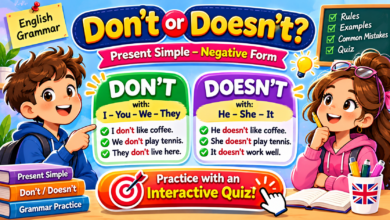
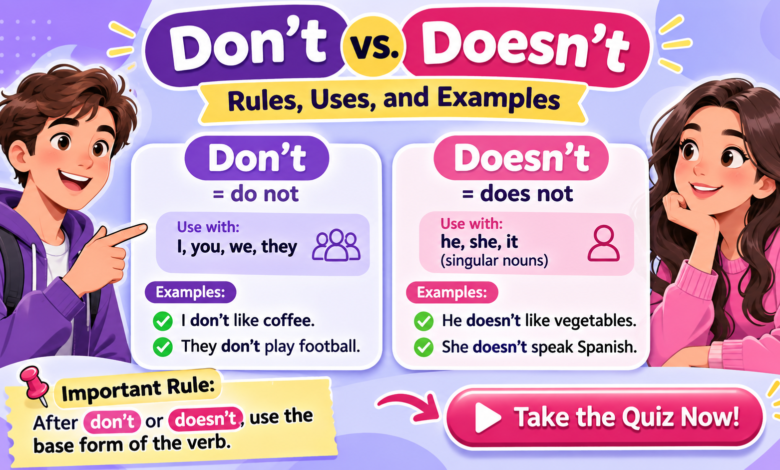
Don’t is the contraction of do not. We use it to make negative sentences with these subjects:
- I
- You
- We
- They
Examples:
- I don’t like coffee.
- You don’t need to worry.
- We don’t play football on Mondays.
- They don’t live in London.
In each sentence, don’t tells us that something does not happen or is not true.
2. What Does “Doesn’t” Mean?
Doesn’t is the contraction of does not. We use it with third-person singular subjects:
- He
- She
- It
- A singular person’s name
- A singular noun
Examples:
- He doesn’t like vegetables.
- She doesn’t speak Spanish.
- It doesn’t work properly.
- Adam doesn’t play tennis.
- My brother doesn’t drink coffee.
Remember: Use doesn’t when the subject is he, she, it, or a singular noun.
3. The Main Grammar Rule: Don’t or Doesn’t?
Here is an easy way to remember the difference:
| Subject | Negative form | Example |
|---|---|---|
| I | Don’t | I don’t swim. |
| You | Don’t | You don’t drive. |
| We | Don’t | We don’t agree. |
| They | Don’t | They don’t study French. |
| He | Doesn’t | He doesn’t cook. |
| She | Doesn’t | She doesn’t sing. |
| It | Doesn’t | It doesn’t rain much. |
Quick tip: Use DON’T with I, YOU, WE, and THEY. Use DOESN’T with HE, SHE, and IT.
4. Important Rule: Use the Base Form of the Verb
One of the most common mistakes English learners make is adding -s to the main verb after doesn’t.
When you use doesn’t, the main verb must be in its base form (without -s, -es, or -ies).
❌ She doesn’t likes pizza.
✅ She doesn’t like pizza.
❌ He doesn’t plays football.
✅ He doesn’t play football.
❌ My father doesn’t watches TV.
✅ My father doesn’t watch TV.
Why? Because the third-person singular form is already included in does. Therefore, we do not add -s to the main verb.
The same base-verb rule applies after don’t:
- They don’t like fish.
- We don’t watch TV every day.
5. Don’t and Doesn’t in Everyday English
Let’s look at more examples to understand how these negative forms are used in everyday situations.
Talking about likes and dislikes:
- I don’t like spicy food.
- She doesn’t like horror movies.
- They don’t enjoy cold weather.
Talking about daily routines:
- He doesn’t wake up early.
- We don’t go to school on Sundays.
- My sister doesn’t walk to work.
Talking about facts and habits:
- Cats don’t eat chocolate.
- The sun doesn’t shine at night.
- My parents don’t work on weekends.
6. Common Mistakes to Avoid
Pay attention to these common grammar mistakes:
| Incorrect ❌ | Correct ✅ |
|---|---|
| He don’t play football. | He doesn’t play football. |
| She don’t like tea. | She doesn’t like tea. |
| They doesn’t work here. | They don’t work here. |
| He doesn’t goes to school. | He doesn’t go to school. |
| My mother doesn’t cooks. | My mother doesn’t cook. |
The most important thing to remember is that the subject determines whether you use don’t or doesn’t.
7. Quick Grammar Summary
- DON’T = DO NOT: Use with I, you, we, and they.
- DOESN’T = DOES NOT: Use with he, she, it, and singular nouns.
- Always use the base form of the main verb after don’t and doesn’t.
Ready to Test Your Knowledge? 🎯
Now it’s time to practise!
Reading grammar rules is a great first step, but the best way to master English grammar is through practice.
Take the interactive Don’t or Doesn’t English Grammar Quiz below! Choose the correct answer, check your progress, and see how well you understand the difference between these two important negative forms.
Good luck, and enjoy learning English! 🚀