Family Tree in English: Learn Family Members and Relationships with Examples
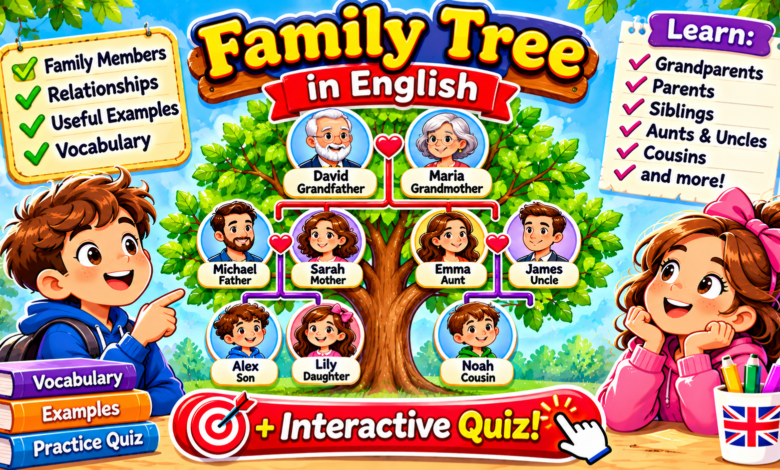
Do you know the difference between an aunt, an uncle, a cousin and a nephew? Can you identify someone’s relationship simply by looking at a family tree?
Learning family members and family relationships in English is an important part of developing your vocabulary and communication skills. It helps you introduce your family, describe relatives and talk about how people are connected.
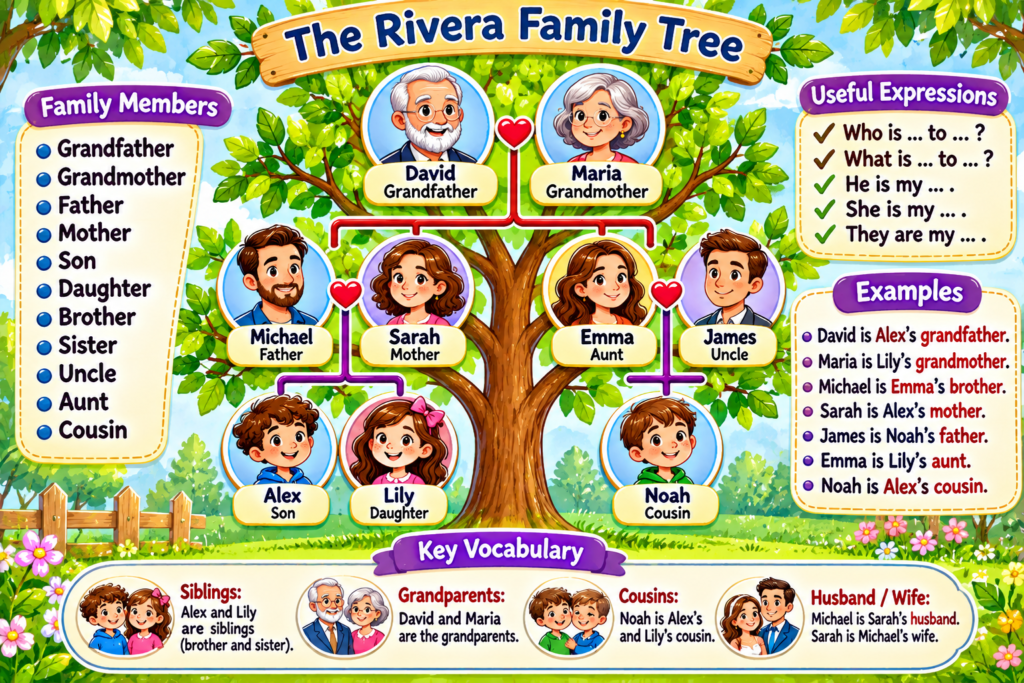
In this lesson, we’ll explore a colourful family tree called The Rivera Family Tree. You’ll learn the names of family members, understand their relationships and practise asking and answering questions about family connections.
Study the family tree carefully as you read. It will help you understand the examples and remember the vocabulary more easily!
1. Meet the Rivera Family
Let’s start by getting to know the people in our family tree.
The Rivera family has three generations.
First Generation: The Grandparents
At the top of the family tree, we have David and Maria.
- David is the grandfather.
- Maria is the grandmother.
- David and Maria are husband and wife.
They have two children: Michael and Emma.
Second Generation: The Parents
Michael and Emma are David and Maria’s children.
- Michael is their son.
- Emma is their daughter.
- Michael and Emma are brother and sister.
Michael is married to Sarah, while Emma is married to James.
Third Generation: The Grandchildren
Michael and Sarah have two children:
- Alex is their son.
- Lily is their daughter.
Emma and James have one child:
- Noah is their son.
Therefore, David and Maria have three grandchildren: Alex, Lily and Noah.
2. Immediate Family Members
Immediate family members are the people closest to us in our family.
| Vocabulary | Meaning |
|---|---|
| Father | Male parent |
| Mother | Female parent |
| Parents | Father and mother |
| Son | Male child |
| Daughter | Female child |
| Children | Sons and daughters |
| Brother | Male sibling |
| Sister | Female sibling |
| Siblings | Brothers and sisters |
| Husband | Married man |
| Wife | Married woman |
Examples from the Rivera Family
- Michael is Alex’s father.
- Sarah is Lily’s mother.
- Alex is Michael’s son.
- Lily is Michael’s daughter.
- Emma is David’s daughter.
- Michael is Emma’s brother.
- Emma is Michael’s sister.
- Sarah is Michael’s wife.
- Michael is Sarah’s husband.
Remember: Brothers and sisters are called siblings.
Alex and Lily are siblings because they have the same parents, Michael and Sarah.
3. Grandparents and Grandchildren
Grandparents are the parents of your mother or father.
| Vocabulary | Meaning |
|---|---|
| Grandfather | Your mother’s or father’s father |
| Grandmother | Your mother’s or father’s mother |
| Grandparents | Grandfather and grandmother |
| Grandson | Male grandchild |
| Granddaughter | Female grandchild |
| Grandchildren | Grandsons and granddaughters |
Examples from the Rivera Family
- David is Alex’s grandfather.
- Maria is Lily’s grandmother.
- David is Noah’s grandfather.
- Noah is David’s grandson.
- Lily is Maria’s granddaughter.
- Alex is David’s grandson.
Important: David and Maria have three grandchildren: Alex, Lily and Noah.
4. Aunts, Uncles and Cousins
These vocabulary words describe relationships between different branches of a family.
| Vocabulary | Meaning |
|---|---|
| Uncle | Your father’s or mother’s brother |
| Aunt | Your father’s or mother’s sister |
| Cousin | The child of your aunt or uncle |
| Nephew | Your brother’s or sister’s son |
| Niece | Your brother’s or sister’s daughter |
Examples from the Rivera Family
- Emma is Alex’s aunt.
- Emma is Lily’s aunt.
- Michael is Noah’s uncle.
- Alex is Noah’s cousin.
- Lily is Noah’s cousin.
- Noah is Alex’s cousin.
Let’s understand why!
Michael and Emma are brother and sister. Michael’s children are Alex and Lily, while Emma’s child is Noah.
Since their parents are siblings, Alex, Lily and Noah are cousins.
Also, Emma is Alex and Lily’s aunt, while Michael is Noah’s uncle.
James is also Alex and Lily’s uncle by marriage because he is married to their aunt Emma.
5. Family Relationships by Marriage
Marriage creates additional family relationships. We often use the expression in-law to describe these relationships.
| Vocabulary | Meaning |
|---|---|
| Father-in-law | Your husband’s or wife’s father |
| Mother-in-law | Your husband’s or wife’s mother |
| Brother-in-law | Your husband’s or wife’s brother, or your sister’s husband |
| Sister-in-law | Your husband’s or wife’s sister, or your brother’s wife |
| Son-in-law | Your daughter’s husband |
| Daughter-in-law | Your son’s wife |
Examples from the Rivera Family
- Sarah is Michael’s wife.
- James is Emma’s husband.
- Sarah is Emma’s sister-in-law.
- James is Michael’s brother-in-law.
- David is Sarah’s father-in-law.
- Maria is Sarah’s mother-in-law.
These examples show how marriage connects different family members.
6. How to Ask About Family Relationships in English
When looking at a family tree, we often need to ask how two people are related.
Here are two useful question patterns:
Question 1: Who is … to …?
We use this question to ask about the relationship between two people.
Examples:
Question: Who is Sarah to Alex?
Answer: Sarah is Alex’s mother.
Question: Who is David to Lily?
Answer: David is Lily’s grandfather.
Question: Who is Emma to Noah?
Answer: Emma is Noah’s mother.
Question 2: What is … to …?
We can also use this question to ask about someone’s family relationship.
Examples:
Question: What is Emma to Alex?
Answer: Emma is Alex’s aunt.
Question: What is Michael to Noah?
Answer: Michael is Noah’s uncle.
Question: What is Lily to Alex?
Answer: Lily is Alex’s sister.
Useful Answer Patterns
When answering these questions, you can use:
- He is my father.
- She is my mother.
- He is my uncle.
- She is my aunt.
- They are my grandparents.
- They are my cousins.
7. Common Family Vocabulary Mistakes
English learners sometimes confuse family relationships. Let’s look at some common mistakes.
| Incorrect | Correct |
|---|---|
| Your uncle’s son is your nephew. | Your uncle’s son is your cousin. |
| Your mother’s mother is your aunt. | Your mother’s mother is your grandmother. |
| Your brother’s daughter is your cousin. | Your brother’s daughter is your niece. |
| Your sister’s son is your uncle. | Your sister’s son is your nephew. |
| Your father’s brother is your grandfather. | Your father’s brother is your uncle. |
Learning tip: Whenever you are unsure about a family relationship, go back to the family tree and follow the connecting lines.
8. Quick Vocabulary Revision
Let’s revise the most important family vocabulary from our lesson.
| Category | Family Vocabulary |
|---|---|
| Parents | Father, Mother, Parents |
| Children | Son, Daughter, Children |
| Siblings | Brother, Sister, Siblings |
| Grandparents | Grandfather, Grandmother |
| Grandchildren | Grandson, Granddaughter |
| Extended Family | Uncle, Aunt, Cousin, Nephew, Niece |
| Marriage | Husband, Wife |
| In-Laws | Father-in-law, Mother-in-law, Brother-in-law, Sister-in-law |
Try to use these words in your own sentences. Practising with a family tree is an excellent way to remember them.
9. 🌳 Challenge Yourself: Family Tree Interactive Quiz!
Now that you’ve explored the Rivera family and learned how its members are related, it’s time to check your understanding!
Can you identify Sarah’s relationship to Alex? Do you know what Emma is to Lily? Can you tell the difference between a nephew and a cousin?
Take our Family Tree Interactive Quiz and put your vocabulary knowledge to the test!
What awaits you?
- 🌳 An illustrated family tree to help you identify relationships.
- 🎯 20 randomly selected questions from a bank of 40 questions.
- ✅ Three answer choices for every question.
- 💡 Instant feedback with helpful explanations.
- 📊 A live scoreboard showing correct and incorrect answers.
- 🏆 A final score and detailed review of your mistakes.
Can you answer all 20 questions correctly and become the Family Tree Champion?
👇 The challenge starts now! Click the START QUIZ button below and test your knowledge of family members and relationships in English!
Good luck, and enjoy learning English! 🎉