Telling the Time in English: Rules, Examples and Practice
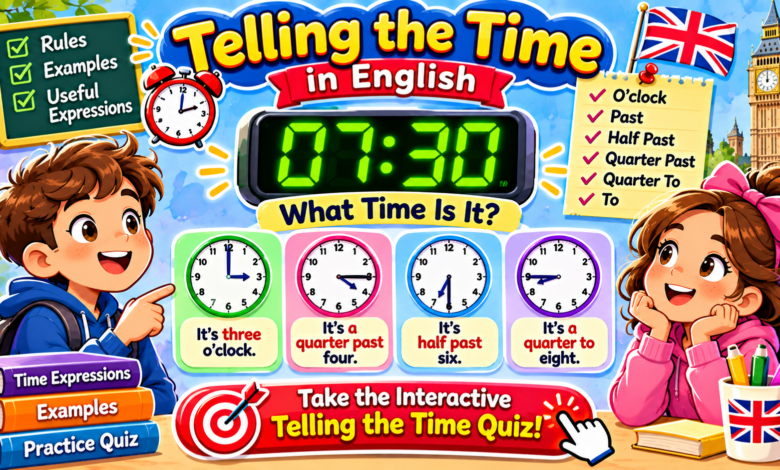
What time is it? Can you tell the time in English? ⏰
Learning how to tell the time in English is an important skill for everyday communication. We use time expressions when talking about school, work, appointments, daily routines and special events.
However, some English learners find it difficult to understand expressions such as half past, quarter to, quarter past and ten to.
Don’t worry! In this lesson, you’ll learn how to ask and tell the time in English, understand digital clock displays, explore useful time expressions and practise with simple examples.
Let’s get started!
1. How to Ask About the Time in English
There are several ways to ask someone about the time.
The most common question is:
What time is it?
Here are some other useful expressions:
- What’s the time?
- Could you tell me the time, please?
- Do you know what time it is?
How to Answer
We usually begin our answer with:
- It’s seven o’clock.
- It’s half past eight.
- It’s a quarter past nine.
- It’s twenty to ten.
For example:
A: Excuse me, what time is it?
B: It’s half past seven.
2. Telling the Time with a Digital Clock
A digital clock displays time using numbers, usually separated by a colon.
For example:
| Digital Time | How to Say It |
|---|---|
| 07:00 | Seven o’clock |
| 08:10 | Ten past eight |
| 09:15 | A quarter past nine |
| 10:20 | Twenty past ten |
| 11:30 | Half past eleven |
| 12:40 | Twenty to one |
| 02:45 | A quarter to three |
| 04:50 | Ten to five |
Important: The numbers before the colon show the hour, while the numbers after the colon show the minutes.
Let’s learn the most common expressions!
3. Understanding O’CLOCK
We use o’clock when the time is exactly on the hour, with zero minutes.
Examples:
- 01:00 → It’s one o’clock.
- 03:00 → It’s three o’clock.
- 06:00 → It’s six o’clock.
- 09:00 → It’s nine o’clock.
- 12:00 → It’s twelve o’clock.
Remember: We don’t normally use o’clock when minutes are included.
For example:
- ✅ It’s five o’clock.
- ❌ It’s five ten o’clock.
- ✅ It’s ten past five.
4. Understanding PAST
We use PAST when the minutes are after the hour, from 1 to 30.
The structure is:
Minutes + PAST + Hour
Examples:
| Digital Time | Expression |
|---|---|
| 05:05 | Five past five |
| 06:10 | Ten past six |
| 07:15 | A quarter past seven |
| 08:20 | Twenty past eight |
| 09:25 | Twenty-five past nine |
| 10:30 | Half past ten |
What Does HALF PAST Mean?
Half past means 30 minutes after the hour.
For example:
- 07:30 → It’s half past seven.
- 09:30 → It’s half past nine.
- 11:30 → It’s half past eleven.
💡 Remember: Half past seven means 7:30, not 6:30!
5. Understanding TO
We use TO when we talk about the minutes remaining before the next hour, usually from 31 to 59.
The structure is:
Minutes + TO + Next Hour
Examples:
| Digital Time | Expression |
|---|---|
| 04:35 | Twenty-five to five |
| 05:40 | Twenty to six |
| 06:45 | A quarter to seven |
| 07:50 | Ten to eight |
| 08:55 | Five to nine |
What Does QUARTER TO Mean?
A quarter to means 15 minutes before the next hour.
For example:
- 06:45 → It’s a quarter to seven.
- 08:45 → It’s a quarter to nine.
- 11:45 → It’s a quarter to twelve.
💡 Important: When using TO, remember to mention the NEXT hour, not the current hour.
For example:
07:50 means ten to eight, not ten to seven.
6. Quarter Past, Half Past and Quarter To
These three expressions are particularly important when learning how to tell the time.
| Expression | Meaning | Example |
|---|---|---|
| A quarter past | 15 minutes after the hour | 07:15 |
| Half past | 30 minutes after the hour | 07:30 |
| A quarter to | 15 minutes before the next hour | 07:45 |
Think of an hour as 60 minutes:
- A quarter = 15 minutes.
- Half = 30 minutes.
- Three quarters = 45 minutes.
Once you understand these expressions, telling the time becomes much easier!
7. Reading Minutes: More Examples
Let’s practise with different digital clock displays.
Examples using PAST:
- 02:05 → Five past two.
- 03:10 → Ten past three.
- 04:15 → A quarter past four.
- 05:20 → Twenty past five.
- 06:25 → Twenty-five past six.
Examples using TO:
- 07:35 → Twenty-five to eight.
- 08:40 → Twenty to nine.
- 09:45 → A quarter to ten.
- 10:50 → Ten to eleven.
- 11:55 → Five to twelve.
Remember the golden rule:
- PAST: Minutes after the current hour.
- TO: Minutes remaining before the next hour.
8. AM and PM: Morning and Evening
In English, we often use AM and PM to distinguish between morning and afternoon or evening.
| Expression | Meaning |
|---|---|
| AM | From midnight to before noon |
| PM | From noon to before midnight |
Examples:
- 07:00 AM → Seven o’clock in the morning.
- 10:30 AM → Half past ten in the morning.
- 02:00 PM → Two o’clock in the afternoon.
- 08:30 PM → Half past eight in the evening.
Important:
- 12:00 AM means midnight.
- 12:00 PM means noon.
When the context is already clear, we don’t always need to say AM or PM.
9. Common Mistakes When Telling the Time
Here are some mistakes English learners should avoid.
| Incorrect | Correct |
|---|---|
| It’s seven half. | It’s half past seven. |
| It’s a half past eight. | It’s half past eight. |
| It’s fifteen past nine. | It’s a quarter past nine. |
| It’s fifteen to ten. | It’s a quarter to ten. |
| It’s ten to seven (for 06:50). | It’s ten to seven. |
| It’s five to eight (for 07:55). | It’s five to eight. |
Remember that 06:50 is ten minutes before seven, while 07:55 is five minutes before eight.
10. Useful Questions and Answers About Daily Activities
We don’t only ask about the time. We also use time expressions to talk about our daily routines.
Here are some useful examples:
A: What time do you get up?
B: I get up at seven o’clock.
A: What time does school start?
B: It starts at eight thirty.
A: What time do you have lunch?
B: I have lunch at half past twelve.
A: What time do you go to bed?
B: I go to bed at ten o’clock.
💡 Grammar tip: Use the preposition AT when mentioning an exact time.
Examples:
- I wake up at six o’clock.
- She goes to school at seven thirty.
- They have dinner at eight PM.
11. Quick Summary: The Rules of Telling the Time
Let’s review the most important expressions:
| Minutes | Expression | Example |
|---|---|---|
| 00 | O’clock | 05:00 – Five o’clock |
| 01–14 | Past | 05:10 – Ten past five |
| 15 | A quarter past | 05:15 – A quarter past five |
| 16–29 | Past | 05:20 – Twenty past five |
| 30 | Half past | 05:30 – Half past five |
| 31–44 | To | 05:40 – Twenty to six |
| 45 | A quarter to | 05:45 – A quarter to six |
| 46–59 | To | 05:50 – Ten to six |
These are the common traditional expressions for telling the time. You can also read a digital time directly, such as five forty for 05:40.
12. Ready for the Telling the Time Challenge? 🏆
Now that you’ve learned how to tell the time in English, it’s time to put your knowledge to the test!
Can you read a digital clock correctly? Do you know the difference between quarter past, half past and quarter to?
Try our interactive Telling the Time Quiz and challenge yourself!
⏰ What awaits you?
- 20 questions selected randomly from a larger question bank.
- A large digital clock displaying different times.
- Three answer choices for every question.
- Instant feedback and helpful explanations.
- A live scoreboard showing your correct and incorrect answers.
- Animated rewards and a final score.
🏆 Can you answer all 20 questions correctly and become a Telling the Time Champion?
👇 It’s time to prove your skills! Click the START QUIZ button below and begin your challenge!
Good luck, and have fun learning English! 🎉